AMD attacks Nvidia's FP64 emulation at SC26, touts native double-precision on Instinct MI430X — says Ozaki schemes fit less than 10% of HPC workloads and triple memory use and emulated FP64 is a poor fit for many HPC workloads
AMD is touting the benefits of the native FP64 support provided by its MI430X accelerator at Supercomputing 2026. The company says that Ozaki FP64 emulation only covers the needs of a small portion of HPC workloads, making the MI430X a unique foundation for next-gen supercomputing installations.
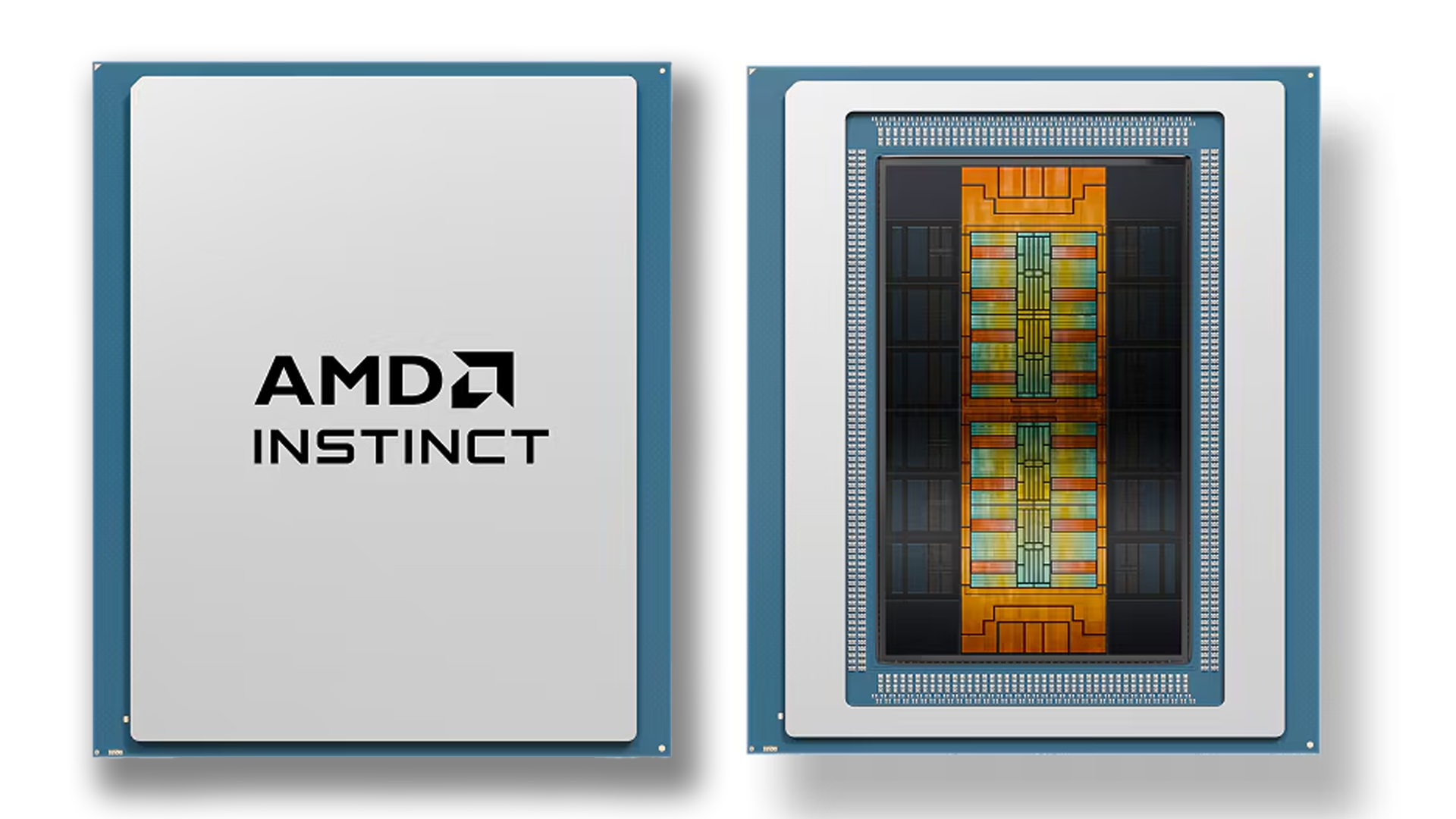
At Supercomputing 2026 (SC26) in Chicago, AMD is indirectly criticizing Nvidia for lacking native FP64 (double-precision floating-point) support in its data center GPU products. FP64 is crucial for scientific computing and simulation, which are the focus of SC26. AMD highlights the value of its latest Instinct MI430X accelerator for customers who still need native FP64, such as national laboratories and supercomputing centers.
Nvidia has shifted its focus to lower-precision matrix math in data center GPUs to accommodate the growing AI market, which requires more compute power, while the demand for double-precision math has remained relatively flat. To compensate, Nvidia uses techniques like the Ozaki schemes to emulate FP64 operations. However, AMD argues that emulation is not a substitute for native double-precision processing for several reasons.
Firstly, Ozaki emulation assumes that the workload resembles dense general matrix multiplication (GEMM). AMD's own profiling shows that only less than 10% of HPC workloads perform dense GEMM operations, so emulation is not a suitable replacement for native compute. Dense linear algebra is the one common workload for which AMD claims Ozaki emulation is a natural fit.
For other workloads like sparse iterative linear algebra, stencils, hydrodynamics, high-order finite element analysis, Monte Carlo, and particle transport, developers still need strong FP64 vector performance for optimal results.
Moreover, even for workloads that map well onto GEMM operations, AMD notes that the matrix sizes must be large enough to achieve the best performance, and that may not always be feasible. Incorrectly scaled operands can also negatively impact performance. Additionally, emulation methods using Ozaki can significantly increase the memory footprint of an application, requiring up to three times more capacity than native FP64.
As memory capacity is tied to GPUs in modern supercomputing installations, this could lead to increased floor space, power, and cooling requirements.
AMD's MI430X accelerator offers 432GB of HBM4 memory capacity per node, allowing customers to provision fewer GPUs and compute nodes, saving on networking, power, and floor space. The MI430X also provides 9.2 PFLOPS of theoretical FP4 compute performance for AI inference, but this is in comparison to the 40.3 PFLOPS offered by the AI-focused MI455X accelerator.
The MI430X's interconnect, optimized for latency-sensitive operations, is less suited for massive scale-up domains compared to the 72 MI455X accelerators in a Helios rack.
Written by urgent.news from Tom's Hardware's reporting — not their text. Machine-written — may contain errors; check the original before relying on it.