AI Is Giving Optical Computing Another Shot
The idea of computing with light has been around for over 70 years, but until recently it’s remained largely in the realm of research. Over the past few years, though, optical computing has emerged as a fast-growing industry: Market valuation of companies in this sector now totals US $2.22 billion, up from $0.4 billion in 2022. One projection suggests that the market will continue to grow…
The concept of using light for computing has been around for more than seven decades, but it largely remained in the realm of research. However, in recent years, optical computing has become a fast-growing industry, with market valuation now reaching $2.22 billion, up from $0.4 billion in 2022. This surge can be attributed to the increasing demand for energy-efficient solutions, driven by the limitations of AI inference.
According to Peter McMahon, an associate professor of applied and engineering physics at Cornell University, the main issue is that AI inference has become limited by power consumption. Optical systems are seen as a promising alternative to traditional data centers that consume large amounts of power during AI inference tasks.
Optics holds the potential to perform the same mathematical operations as GPUs at a significantly lower power level. This would be a major shift, but it has already attracted the attention of numerous startups across the globe, including in the United States, China, Germany, and Israel. While competing with GPU manufacturers like Nvidia may be ambitious, the investment in optical computing has spurred the development of alternative AI algorithms, scientific computing approaches, and in-network computing techniques.
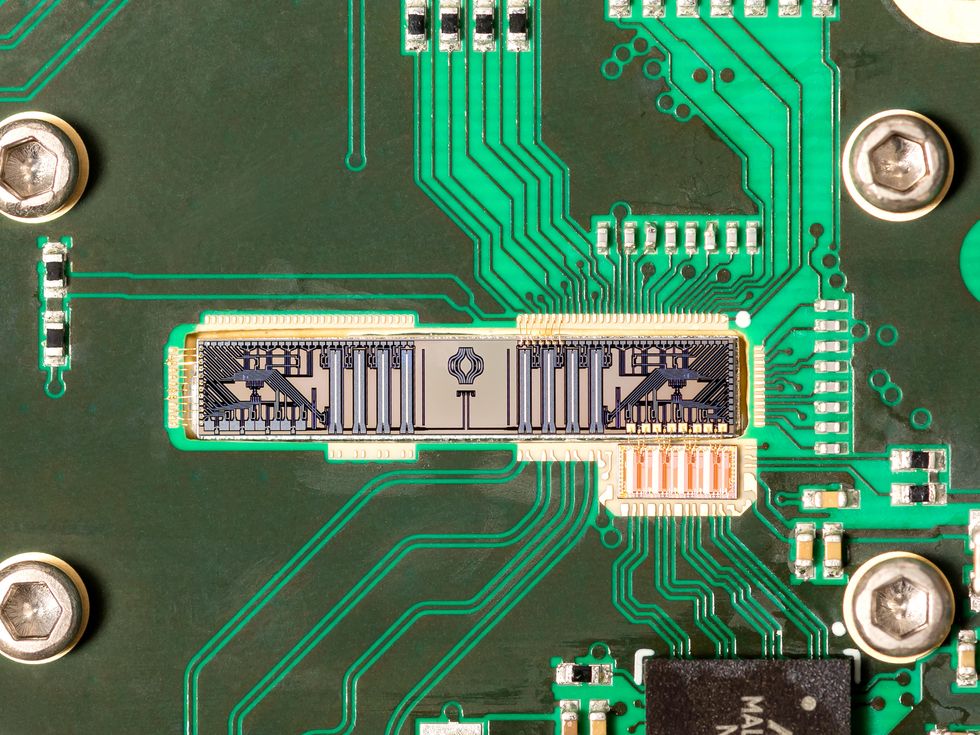
Companies like Optalysys are exploring the integration of optical-computing elements into networking paths, where data centers already use light. Their on-chip optical element, known as a Fourier transform calculator, enables efficient computation. Optalysys suggests that even if the technology doesn't align perfectly with AI, it could still provide unique capabilities for photonic systems.
The bulk of AI energy consumption is attributed to inference, which involves numerous operations such as matrix-vector multiplication. In the 1970s, Joseph W. Goodman and his colleagues proposed using light to perform matrix-vector multiplication. This method involves encoding a vector of length N into light using N light-emitting diodes, spreading the light using a cylindrical lens, and then performing multiplication at each pixel through an attenuator.
Finally, the light is re-collected and the final vector is measured by detectors. According to McMahon, the computational expense of matrix-vector multiplication in AI is significantly higher than in traditional computing. While implementing this method in optics would require encoding the data and decoding the results, the energy savings could be substantial, potentially reaching a factor of 100,000 compared to electronic systems. However, the actual benefits will depend on the size of the system and the specific AI application.
Written by urgent.news from IEEE Spectrum's reporting — not their text. Machine-written — may contain errors; check the original before relying on it.