TokenEconomizer: Learning from Experience to Make AI Coding Agents More Efficient
AI coding agents are increasingly help developers fix bugs and build features largely on their own, but every interaction with their models consumes tokens. In each session, an agent sends instructions, tool descriptions, and session history to its model. Most efforts to reduce this cost focus on individual tasks. Yet developers return to the same […] The post TokenEconomizer: Learning from…
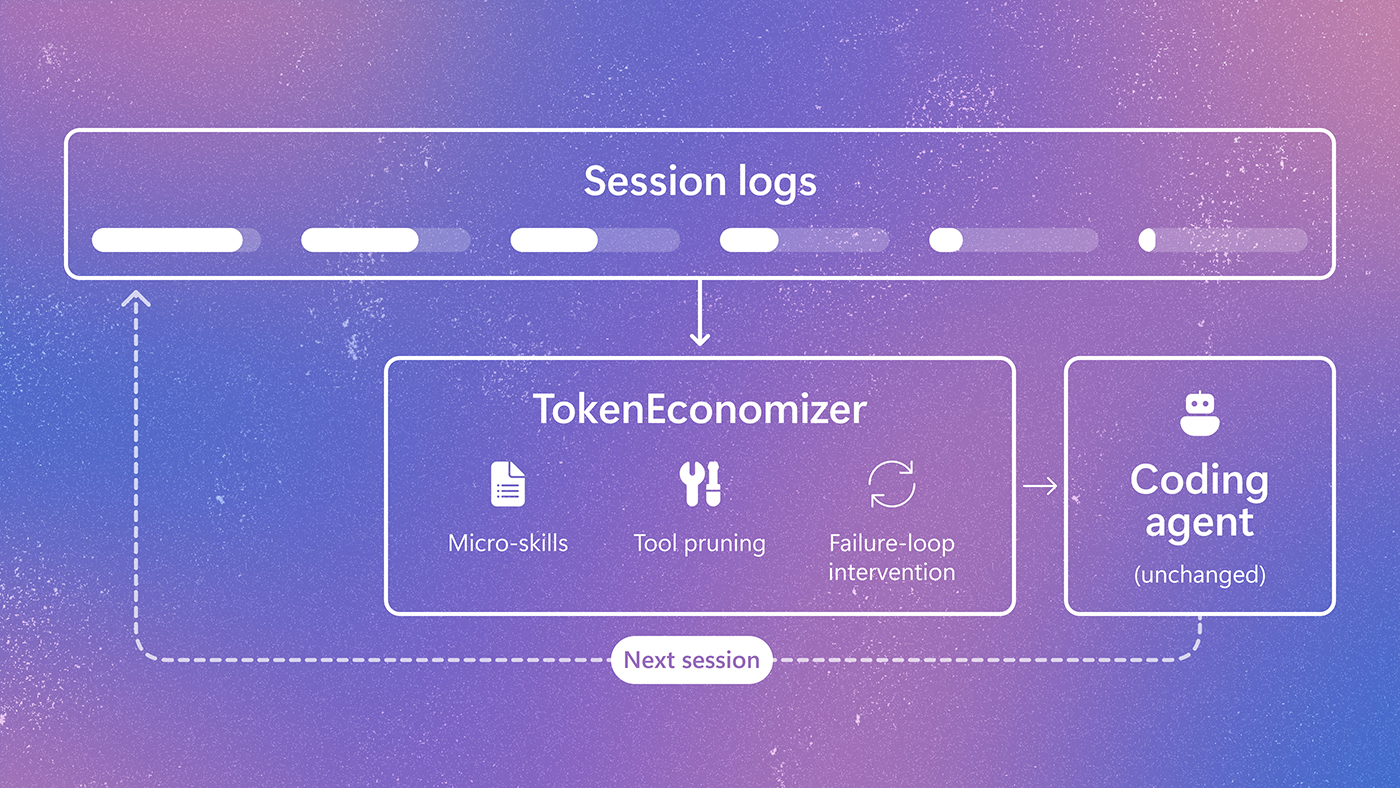
AI coding agents offer developers the ability to automate bug fixing and feature building within a single codebase. However, these agents frequently begin each session anew, relearning facts they have already encountered and loading tools they do not need. TokenEconomizer is an open-source plugin designed to learn from an agent's past sessions in a repository to minimize unnecessary usage in subsequent sessions, without altering the agent or its underlying model.
In tests involving 277 bug-fixing tasks across 277 repositories, TokenEconomizer reduced costs by 18.4-30.9% while maintaining task success rates. As developers increasingly rely on AI coding agents to perform tasks autonomously, each interaction consumes tokens, making cost reduction a critical concern. TokenEconomizer, developed jointly by UC Berkeley, Microsoft Research, and Microsoft Security, capitalizes on experience within a repository to guide future agent performance more efficiently.
After completing a session, TokenEconomizer analyzes the session log and updates its knowledge of the repository. It employs three key mechanisms to reduce waste: capturing repository-specific knowledge through micro-skills, pruning unused tools, and intervening when an agent repeatedly encounters failures. These actions are implemented using existing interfaces provided by the agent, ensuring seamless integration without the need for modifications.
The key takeaway is that cost control measures must be adaptable to the specific repository context rather than applying a one-size-fits-all strategy.
Written by urgent.news from Microsoft Research's reporting — not their text. Machine-written — may contain errors; check the original before relying on it.