Home at last: Banned and exiled Nobel laureate Miguel Angel Asturias returns to Guatemala in a corn-shaped urn half a century later
GUATEMALA CITY, Nov 15 — Indigenous Guatemalans burned incense and made offerings at an ancestral site to say good...
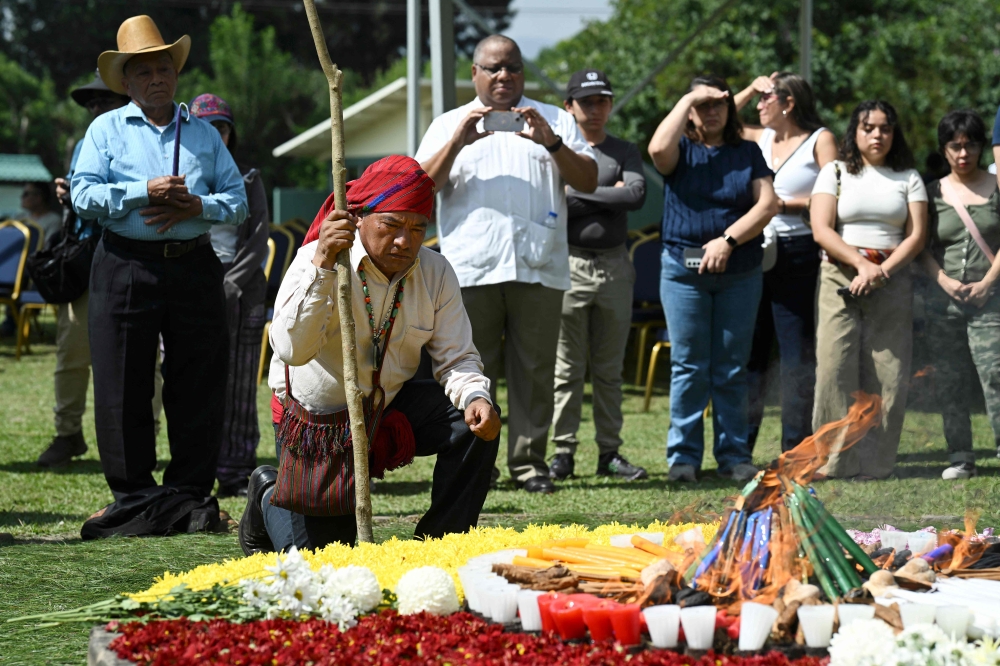
Guatemala welcomed back the ashes of acclaimed author and Nobel laureate Miguel Angel Asturias on Saturday, half a century after his death in 1974. The ceremony, held at the Mayan archaeological site of Kaminaljuyu, marked a significant moment for the indigenous people of Guatemala and beyond. Asturias, who received the Nobel Prize in Literature in 1967 for denouncing dictators and advocating for indigenous rights, died in Spain at the age of 74 during the Franco dictatorship.
The return of his ashes, shaped like a corn kernel in honor of his 1949 work Men of Maize, was accompanied by offerings and incense from indigenous people at the sacred site. Rigoberta Menchu, a 1992 Nobel peace laureate, praised Asturias' universal impact, stating, "Today we are celebrating something extraordinary... Not just his eternal presence in Guatemala but his eternal presence in the world because he was a universal man."
Asturias lived in Paris before his death and had never returned to Guatemala after a US-backed coup in 1954 stripped him of his nationality and banned his works. His son, Miguel Angel Asturias Amado, explained that the family decided to bring him home after Bernardo Arevalo, a social democrat, became Guatemala's president in 2024. Despite his love for France, Amado felt it was important for their father to return to his homeland.
Historian Artemis Torres noted Asturias' significant contribution to social sciences and literature, particularly his denunciation of oligarchic dictatorships through his novels. Asturias Amado, 85, expressed his emotion at the momentous occasion, stating, "I am choked up with the emotion of this very important moment for my family." The ashes of the beloved author will be interred on Sunday at a cultural center named in his honor.
Written by urgent.news from Malay Mail's reporting — not their text. Machine-written — may contain errors; check the original before relying on it.