What Did the German Term Spread Predict for 2024?
The 10yr-3mo German spread, hitherto a pretty good predictor, inverted at 2022M12. Hitherto a pretty good predictor of German recessions (as labelled by ECRI), the implied probability was 70%, using a plain vanilla spread regression. From Chinn and Ferrara (2026), here are estimated probabilities for a probit regression, estimated up to 2019M12 (black line in […]
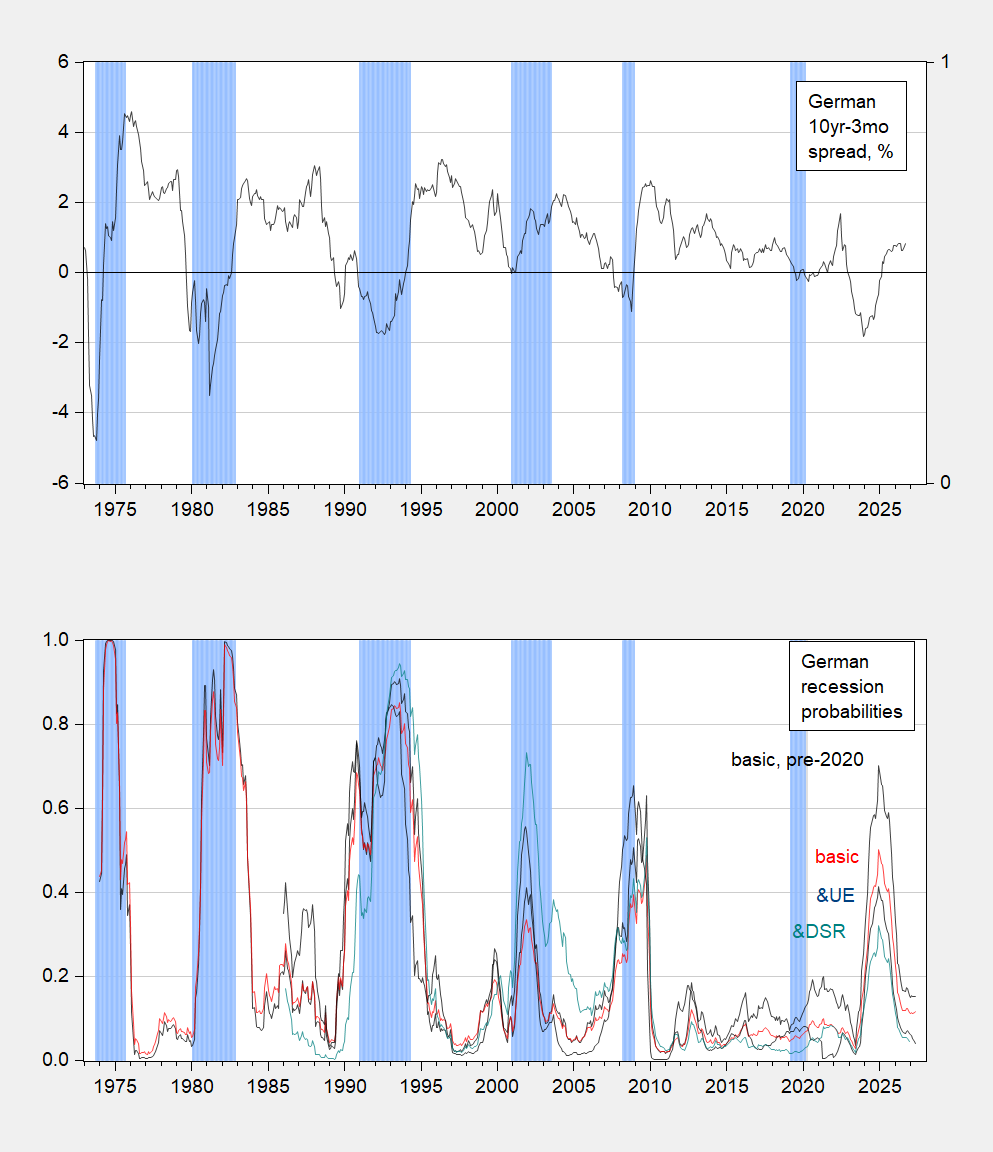
The 10-year minus 3-month German term spread, a reliable indicator of German recessions, inverted in December 2022, forecasting a 70% probability of a recession using a simple regression analysis. A probit regression, as estimated by Chinn and Ferrara (2026) up to December 2019, showed the spread's impact on the short rate, pre-pandemic, full-sample, expected change in unemployment, and debt service ratio.
The top panel of Figure 1 displays the 10-year minus 3-month German term spread in percentage, while the bottom panel presents the probit estimate for the regression on spread, short rate, pre-pandemic, full-sample, including expected change in unemployment, and debt service ratio. ECRI defined peak-to-trough recession dates in light blue.
The term spread and short rate specifications displayed in Figure 1 have relatively high explanatory power for both pre-pandemic and full-sample periods. However, all recessions, except for the 2020 recession, were predicted when using a 40% threshold. Nonetheless, a false positive was also recorded for 2024 using the same threshold.
Including the expected change in unemployment slightly improves the proportion of variation explained (0.29 compared to 0.19 with a basic specification). Including the debt-service ratio further raises the pseudo-R² relative to the basic specification (0.33 compared to 0.19). All coefficients enter with statistically significant and expected coefficients, even the debt-service ratio.
There is no false positive for 2024 using a 40% threshold, suggesting that one may need to include the debt-service ratio to resurrect the term spread as a predictor. Alternatively, one could argue that Germany experienced a recession in 2023-24, as Kemp (2026) notes: "Germany's economy experienced a pronounced recession during 2023–24, with real GDP contracting and growth falling notably behind the rest of the euro area."
However, neither ECRI nor the German Council of Economic Experts have officially declared a post-pandemic recession. This can be explained by the mismatch between peak-to-trough periods: peak employment was in 2024Q4, peak GDP in 2022Q3, peak industrial production in February 2023, while the peak recession probability occurred in December 2024.
Consequently, there has been no recession declaration, as it is defined as a broad, sustained decrease in economic activity. The most plausible interpretation is that the term spread detected the downturn in employment but not in GDP or industrial production.
Written by urgent.news from Econbrowser's reporting — not their text. Machine-written — may contain errors; check the original before relying on it.