Setback for SpaceX Starship rocket's double-catch test
Elon Musk’s company aborted an attempted catch of the rocket’s booster - instead it came down in the ocean.
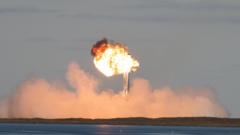
SpaceX's audacious attempt to recover its Starship spacecraft at the launch pad was thwarted when the booster malfunctioned, causing it to end up in the Gulf of Mexico. Despite this setback, the spacecraft managed to soar into orbit, marking its most ambitious test to date. Elon Musk's company had to adjust its expectations after the first part of the double catch failed.
Initially, the booster was intended to return to its Texas pad following liftoff, but an automatic abort led it to land in the water. Nonetheless, the sleek spacecraft continued its journey towards orbit. It will eventually head back to the pad on Saturday for a similar retrieval, provided no further complications arise. This marks the first time the spacecraft will attempt to return to the pad from orbit, secured by mechanical arms attached to the launch tower.
Upon successful completion, the flight is expected to last 22 hours. The initial objective was to retrieve every component of the rocket for recycling purposes, a feat that has never been accomplished anywhere in the world. Musk envisions this as a pathway to achieving rapid and dependable launch rates, crucial for constructing moon bases and sending humans to Mars.
Once in orbit, Starship was set to deliver 26 of SpaceX's most advanced Starlink satellites, which will traverse the globe around 15 times at an altitude of approximately 170 miles (275 kilometers) before returning to the launch site for the grand finale on Saturday. Starship is the largest and most powerful rocket presently in existence, measuring a staggering 407 feet (124 meters) in height.
This colossal rocket comprises both the spacecraft and booster components, which have previously ended up in the ocean either by design or as a result of accidents. Since the first full-scale test flight in 2023, all 14 previous Starships have met their demise in the ocean. During the inaugural test in 2023, multiple engines failed to ignite, prompting the self-destruct system to activate.
The previous test, held in September, successfully reached orbit but did not involve any recovery attempts. SpaceX aims to commence launching Starships from Florida in the coming months and from Louisiana within a few years. Scaled-up infrastructure and full rocket reusability are the keys to transitioning from zero launches to 10, 100, 1,000, and eventually 100,000 launches.
Kiko Dontchev, SpaceX's vice president of launch, stated at a NASA tech summit in Florida that SpaceX's smaller Falcon rockets will continue to operate from Cape Canaveral, carrying astronauts to the International Space Station for NASA and delivering Starlink satellites from California. However, satellites will primarily rely on Falcon rides for now.
Musk's ultimate goal is to replace Falcons with Starships. Currently, Falcon rockets are not fully reusable, as the second stage is discarded with every flight. In contrast, Starship is designed to capture both the first stage and second stage. NASA is funding SpaceX with billions of dollars to ensure the safe landing of Artemis astronauts on the moon using Starships.
Blue Origin, led by Jeff Bezos, is another prominent competitor. NASA anticipates making a decision by the year before the Artemis IV lunar landing — the first manned mission to the moon in over half a century — as to whether to utilize Musk's Starship or Bezos' Blue Moon for transporting moonwalkers. During the upcoming Artemis III mission in the summer, astronauts will practice docking a capsule with both a Blue Moon and a Starship in Earth's orbit, paving the way for an Artemis lunar touchdown as early as 2028.
Written by urgent.news from PBS NewsHour's reporting — not their text. Machine-written — may contain errors; check the original before relying on it.
This story
This is one outlet's version. Read the fullest account.
- SpaceX to attempt double catch of huge Starship rocket myjoyonline.com
- SpaceX's Starship megarocket will launch to orbit on Nov. 13. Will you be able to spot it in the night sky? space.com
- SpaceX's Starship enters Earth's orbit, but booster catch aborted nst.com.my
- SpaceX's Starship soars into orbit after booster malfunction thwarts double catch attempt pbs.org
- Starship flight 15 powers to orbit—setting up a possible catch on Saturday arstechnica.com
- SpaceX to attempt double catch of huge Starship rocket bbc.co.uk