Italy regains investor confidence as economic fundamentals improve
For much of the past fifteen years, Italy was regarded as one of the weaker countries in the Euro area. High public debt, chronically low growth, fragile banks and frequent changes...
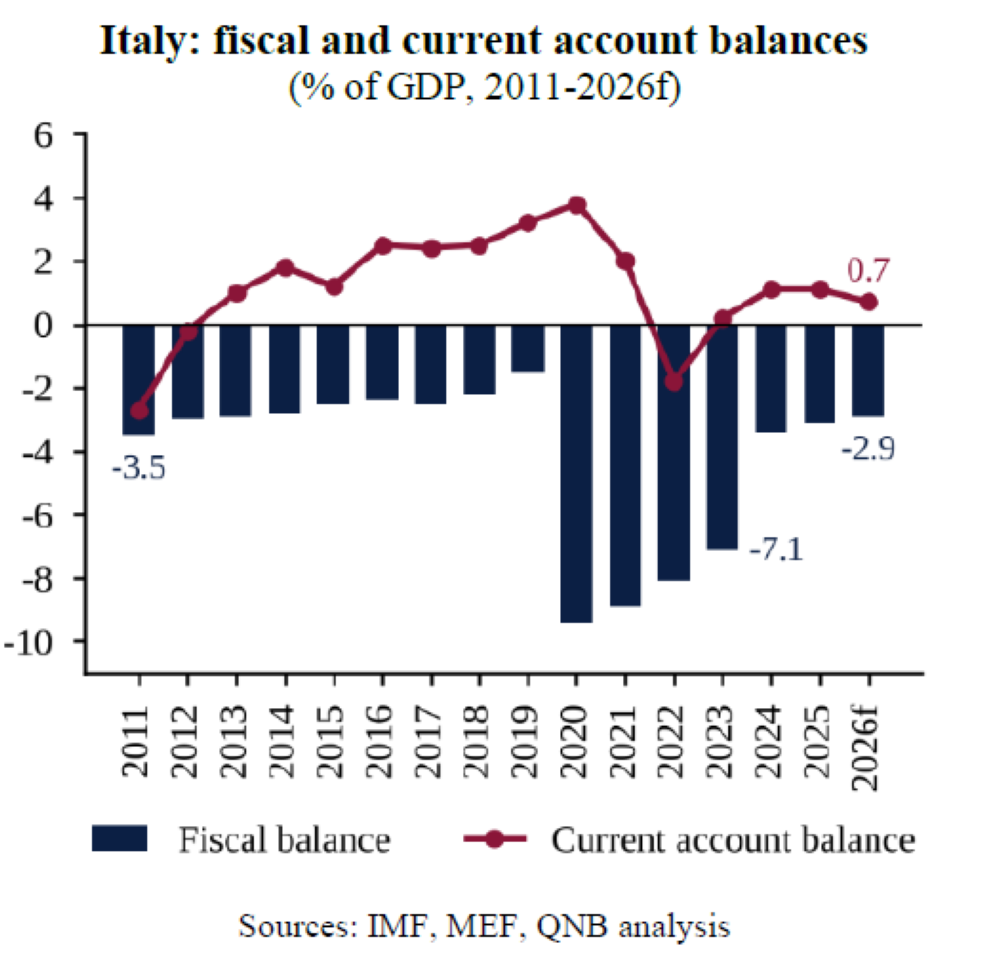
Italy has regained investor confidence as its economic fundamentals have improved. For much of the past fifteen years, Italy was considered one of the weaker economies in the Euro area due to high public debt, low growth, weak banks and frequent government changes. Investor doubts over Italy's debt sustainability were evident in September 2022, with the spread between Italian and German 10-year yields reaching 251 basis points.
However, Italy has undergone a remarkable turnaround. By January 2026, the spread had narrowed to 59 basis points, the tightest since 2008. Furthermore, Italy's 10-year government bond yield has fallen below France's, an inversion first seen in late 2025. Rating agencies have responded positively to these developments, with Fitch upgrading Italy to BBB+ in September 2025, Moody's raising it to Baa2 in November 2025, and S&P moving its outlook to positive in January 2026.
Recent weeks have seen renewed volatility due to an energy shock, ECB rate hikes and stress in US Treasuries, pushing the spread above 100 basis points. Despite this, Italian bonds still trade at lower yields than French bonds. The re-rating of Italy rests on solid ground, not just favorable global liquidity conditions. Three key factors have contributed to Italy's comeback: credible fiscal consolidation, political stability, and stronger private-sector and external balance sheets.
Italy has delivered a credible fiscal consolidation, reducing its budget deficit from 7.1% of GDP in 2023 to 2.9% in 2026, which is within the EU's 3% ceiling for the first time since 2019. This fiscal adjustment has been consistent, with a primary surplus since 2024, a critical factor for stabilizing Italy's debt ratio. Additionally, Italy has experienced an unusual period of political stability, with the current government in office since October 2022, the longest-serving in Italy's history.
This stability has allowed for consistent fiscal policies and the implementation of the EU-funded National Recovery and Resilience Plan, which supports public investment and growth. Moreover, Italy's private-sector and external balance sheets have strengthened, with a current account surplus in 2025 and a positive net international investment position of over 15% of GDP.
The banking sector has also improved, with non-performing loans falling to around 2% and the largest lenders posting record profits. While recent global events have caused a brief spike in spreads, Italy's structural improvements suggest that its spreads should remain below historical stress levels. However, the key test lies ahead, with the projected rise in the deficit to 3.4% of GDP in 2027 and upcoming general elections, making it essential for Italy to maintain fiscal discipline to sustain its hard-won credibility.
Written by urgent.news from Qatar Tribune Business's reporting — not their text. Machine-written — may contain errors; check the original before relying on it.
This story
This is one outlet's version. Read the fullest account.
- Italy regains investor confidence as fundamentals improve, says QNB gulf-times.com
- Italy regains investor confidence as economic fundamentals improve, QNB says thepeninsulaqatar.com