Democrats try out a strange new emotion at post-midterms What's Next conference: hope
Democrats spent two days chewing over their future at the What's Next conference and trying to deal with the fact that it looks, for a moment at least, quite bright.
When Democrats organized a post-midterms conference in Denver months after the elections, political consultant Stephanie Valencia anticipated a typical gathering of strategists analyzing results and planning for the future dominated by President Donald Trump. She did not anticipate the room to be filled with an overwhelming sense of hope, as Democrats had triumphed in virtually every contested race, flipped U.S. Senate seats in Mississippi and South Carolina, turned Texas blue, and secured majorities in Congress.
Valencia, co-founder of Equis, which studies Latino voters, expressed astonishment at the newfound optimism, stating that it was the first time they could perceive the contours of a post-Trump era. Over the two-day conference, Democrats deliberated about their future, grappling with the newfound brightness in their prospects. Suddenly, the seemingly impossible became conceivable for a party that had grown accustomed to fretting rather than celebrating.
Speakers discussed achieving a "supermajority," with one data analyst casually suggesting 60 seats in the Senate and presenting a slide highlighting winnable races in Missouri and Utah. Former Secretary of Transportation Pete Buttigieg, among several potential presidential candidates, urged the party to revel in their current success while remaining cautious not to take future victories for granted.
Some delegates cautioned that voters had not rekindled their love for Democrats; instead, they were drawn to them out of frustration over high prices, the Iran war, and concerns about government corruption. No definitive solution emerged to address widespread discontent about affordability and the economy. However, there was a prevailing sense of hope among attendees that they held the power to navigate these challenges.
Jason Delattre and several friends, who had worked on Democratic campaigns in Texas, were astounded by the newfound opportunities available to them. Delattre, wearing a cowboy hat and pin commemorating the victory of U.S. Senate candidate James Talarico, expressed the group's amazement at the power they now possessed. His friend Jose Robbie Juarez echoed this sentiment, emphasizing the significant power at their disposal.
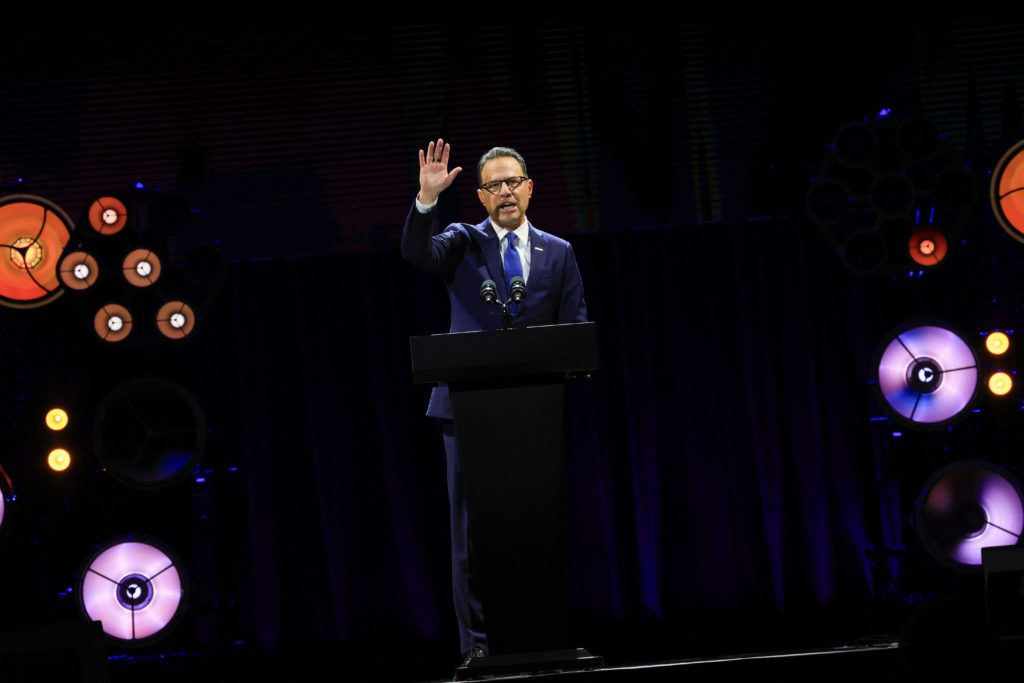
Some even harbored hopes for the possibility of statehood for Puerto Rico. Luis Davila, the Democratic chair on the island, expressed his delight at finally achieving this goal. Pennsylvania Governor Josh Shapiro, a potential White House contender, proposed that his party should aim for a landslide victory in the next presidential race.
Instead of targeting the minimum electoral votes required for victory, they should aim for an impressive 370, which would surpass the record set by Barack Obama in his 2008 historic campaign.
The setting provided an ideal backdrop for the positive atmosphere. The well-known music venue in Denver's hip neighborhood was adorned with concert-style posters of politicians and operatives. Snow-capped peaks framed the horizon outside, adding to the optimistic ambiance. However, some old divisions resurfaced. A small group of protesters from the leftist Sunrise Movement demonstrated outside the gathering, criticizing the event as sponsored by a more centrist group, Majority Democrats, funded by wealthy businesspeople.
One protester, who shouted profanities at potential House Speaker Hakeem Jeffries and labeled him a "traitor," was escorted from the auditorium. Jeffries, appearing at the conference, acknowledged the presence of discord but viewed it as a healthy debate within the party. New Jersey Senator Cory Booker, who may run for president again, welcomed the open discussion and emphasized the party's ideological diversity, describing it as a "big tent party" that covers a broad spectrum of Democratic thought.
Written by urgent.news from PBS NewsHour's reporting — not their text. Machine-written — may contain errors; check the original before relying on it.