As smog hangs over Lahore, Pakistan's new pollution squad races to douse stubble fires
LAHORE: As smog again settles over large parts of South Asia, Pakistani authorities are widening a crackdown on illegal stubble burning, which they say is fuelling the region’s annual pollution crisis.
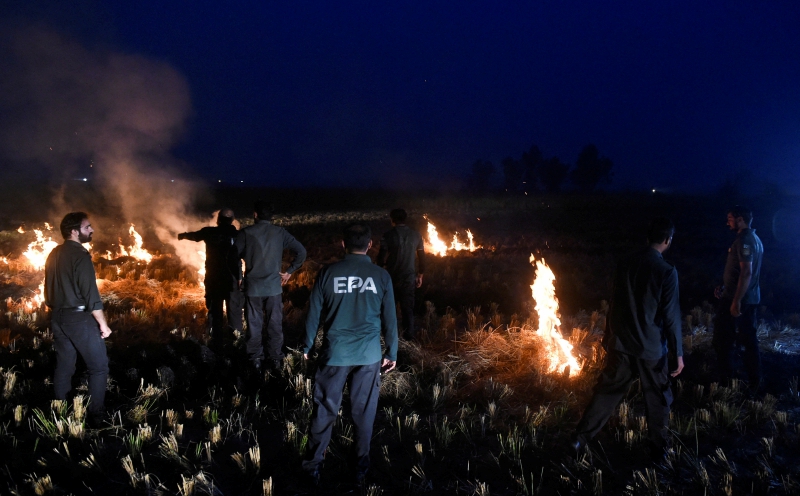
As smog once again blankets large sections of South Asia, Pakistani authorities are intensifying efforts to curb illegal stubble burning, which they claim exacerbates the region's annual pollution crisis. On Thursday, officers from a new rapid-response unit were dispatched to a paddy field near Lahore. Smoke billowed low over the stubble, and the team quickly subdued the fire, averting additional haze over the city, which was recently classified as "very unhealthy" by Swiss air quality monitoring group IQAir.
Farmers in the region traditionally set leftover rice residue aflame after the October harvest, contributing to a toxic blend of industrial emissions, vehicle exhaust, and construction dust that traps under cold winter air, pushing pollution levels to hazardous heights. The newly formed unit represents the first dedicated pollution-fighting force in Pakistan, officials say, and represents a prominent measure in a broader campaign claimed by Punjab officials to be effective.
Satellite imagery indicates that both India and Pakistan have experienced less burned area this year compared to historical averages at this time, despite many local Pakistanis expressing difficulty in perceiving improvements. Punjab's Environment Protection and Climate Change Department, under chief Silwat Saeed, has established a 750-member force comprising 67 rapid-response units across key rice-growing districts.
These teams aim to reach reported field fires within 10 to 15 minutes, while officials patrol paddy areas for signs of burning and accept complaints through various channels, responding as swiftly as possible.
In a single 24-hour span this week, the department received 679 reports of field fires from across Punjab and extinguished 650 of them. Violators face penalties, including fines, arrest, or both. Farmers caught burning stubble face fines of 15,000 Pakistani rupees (approximately US$54) per acre, according to Muhammad Farooq, an assistant director of the Punjab Agriculture Department. Those who fail to pay the fines may also face prosecution and up to a six-month jail term.
The government has also distributed more than 10,000 subsidized super seeders at 60% cost to farmers, while they bear the remaining 40%. Despite these efforts, adoption remains limited. Local farmer Saleem Abbas, who has shifted away from stubble burning, notes that many farmers still favor the practice due to its perceived cost-effectiveness and speed in preparing fields for the next crop.
Pakistan and India have frequently blamed each other for worsening the air quality. Saeed acknowledges the magnitude of the challenge for both nations and has raised the issue with Indian officials at international forums. India's foreign ministry, however, did not respond to a request for comment.
In recent days, patients have formed long lines at local hospitals in Lahore. Abdullah Nayyar, director-general of the Punjab Environment Protection Department, reported that health department data show smog-related throat hospitalizations last month were only 69% of the level recorded in October 2025. Nevertheless, Ahmed Abubakar, a diabetic heart patient, stated that smog has triggered breathing problems and eye infections.
Mohammad Niaz Butt, who experienced blocked nose and throat, bluntly declared, "They are burning it, and nothing is done about it."
Written by urgent.news from New Straits Times's reporting — not their text. Machine-written — may contain errors; check the original before relying on it.
This story
This is one outlet's version. Read the fullest account.
- As smog hangs over Lahore, Pakistan's new pollution squad races to douse stubble fires brecorder.com
- As smog hangs over Lahore, Pakistan’s new pollution squad races to douse stubble fires investing.com
- As smog hangs over Lahore, Pakistan's new pollution squad races to douse stubble fires al-monitor.com