Ancient Star Cluster Hidden in the Milky Way Could Be Nearly as Old as the Universe
Learn how new measurements of a dusty star cluster suggest it may be one of the oldest objects in the Milky Way.
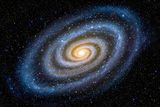
Ancient star cluster found in the Milky Way could be nearly as old as the universe itself. This discovery was made by a team of researchers from Italy and Chile who analyzed an enigmatic group of stars in the inner bulge of the Milky Way. The cluster, known as VVV CL001, is remarkably metal-poor, which suggests that it could be one of the oldest star clusters in the galaxy.
When searching for ancient star clusters, astronomers look for metals, or anything that isn't hydrogen or helium. However, CL001 is very metal-poor, with an iron-to-hydrogen ratio less than one percent of our own sun's. This makes it a promising candidate for being the oldest globular cluster in the Milky Way.
The cluster is located in a dead zone of the galaxy, surrounded by an ancient population of stars, and is difficult to observe due to its faintness and small size. Additionally, CL001's movement is unusual, making it challenging to measure its speed and direction. It was not confirmed to be a globular cluster until 2019, and determining its age and location required innovative methods.
To estimate the cluster's age, the researchers used the color of stars as an indicator. Older stars tend to be fainter and redder. Using images from the Hubble Space Telescope, the team determined that the oldest stars in CL001 are about 13.4 billion years old, which is nearly as old as the universe itself. If this estimate is accurate, the cluster could be one of the oldest objects in existence in the universe.
However, not everyone is convinced by the team's findings. Holger Baumgardt, an associate professor of astrophysics, has expressed doubts about the high degree of uncertainty regarding the distance of CL001, which makes determining its age more challenging. Nonetheless, the discovery of VVV CL001 has provided new insights into the history and evolution of the Milky Way galaxy.
Written by urgent.news from Discover Magazine's reporting — not their text. Machine-written — may contain errors; check the original before relying on it.