Venezuela: President Rodríguez is playing for time, Machado is pushing for elections
Opposition leader Machado has returned to Venezuela to cheers. But Delcy Rodríguez wants to consolidate her power. And the US is pursuing its own plans. When there will be elections is unclear.
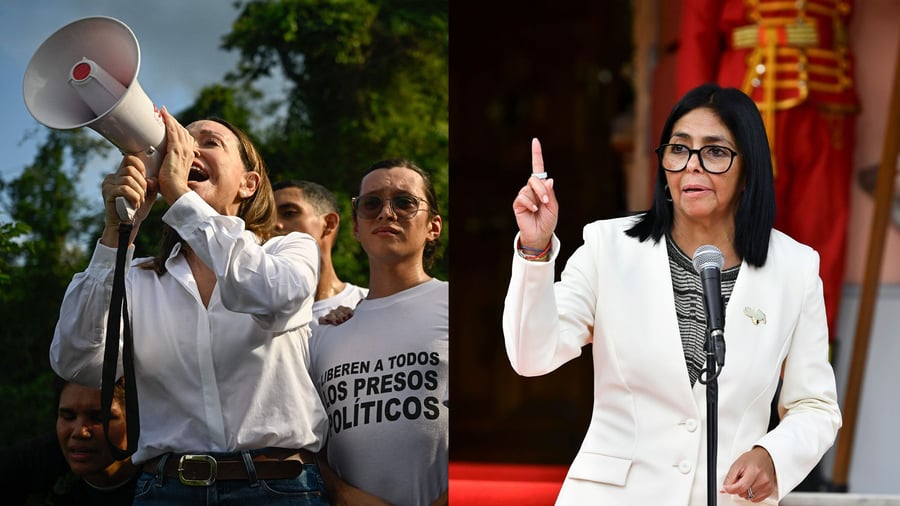
In Caracas, shopping centers and government offices already feature festive decorations by mid-November. President Delcy Rodríguez has anticipated the advent of Christmas, announcing an extended holiday season stretching into January. Rodríguez hopes to divert public attention from politics, allowing her to gain popularity during this period.
Opposition leader María Corina Machado, on the other hand, urges early elections. Nearly three weeks after returning to Caracas with great fanfare, Machado fears her popularity wanes with each passing month until the vote.
Yet, neither politician is openly pushing for a course. Instead, Washington controls the agenda. US Secretary of State Marco Rubio outlined upcoming steps at a G7 foreign ministers' meeting in Paris on Monday: the Supreme Court should be reconstituted in mid-December, followed by a national electoral authority. This would pave the way for presidential elections, hopefully as early as 2027. However, this roadmap is not new. It was negotiated between government and opposition representatives, with US involvement.
Washington's role in the political transition is evident since Maduro's arrest at the beginning of January. The focus is on stabilizing Venezuela, rebuilding its economy, and eventually transitioning to a democratically elected government. Some progress has been made: security has stabilized, political repression has eased, and many political prisoners have been released.
However, over 300 individuals remain in prison for political reasons. The economy is growing, but high inflation and low wages continue to hinder widespread recovery.
Rodríguez presents herself as a reliable partner to the Americans, committed to the political transition. Internally, she remains committed to existing power structures. Analyst Anja Dargatz of the Friedrich-Ebert-Stiftung describes her approach as "relaxations necessary for staying in power." Critics argue that these "relaxations" maintain the status quo.
Rodríguez plans to hold local and regional elections this year to extend the transition and consolidate her political base. The PSUV party, Rodríguez's party, has better organizational structures nationwide compared to Machado's Vente party, which would need to forge alliances with other opposition parties and make political compromises.
Several obstacles remain before presidential elections can be held, including reconstituting the Supreme Court and reforming election rules for free and fair voting. Luis Palacios, an opposition activist, doubts Venezuela can achieve these objectives by mid-2027. Neighboring countries recently held numerous protests, with numbers nearly tripling compared to the previous year.
Many protests were due to power outages, poor public services, and declining purchasing power, but political demands are also increasing. Machado's return to Venezuela has not changed this political weather pattern, according to Dargatz. She needs to translate her renewed popularity into tangible political influence. Machado has become more conciliatory, suggesting that negotiations require offering guarantees to enable this transition. She avoids direct confrontation with Rodríguez, possibly due to US encouragement.
Written by urgent.news from Handelsblatt's reporting — not their text. Machine-written — may contain errors; check the original before relying on it.