The Death of Cheap Supply Chains
Companies that once scoured the globe for the lowest-cost production to feed just-in-time inventories now face unprecedented challenges. The post The Death of Cheap Supply Chains appeared first on Global Finance Magazine .
In the November issue of Global Finance Magazine, an article explores the changing dynamics of supply chains in the post-globalization era. CFOs now face the challenge of determining how much to spend to safeguard against supply disruptions and geopolitical risks. Companies must balance the costs of inventory, capital expenditures, and financing when building resilience into their operations.
One approach to managing risk is through inventory build-ups, as seen at Authority Brands, a consumer services company. In response to tariff-driven price increases, the company negotiated with distributors to lock in stock at existing prices for some of its larger franchisees and company-run locations. However, manufacturers had to raise prices regardless, as costs were rising across the industry.
Other firms, like Trane Technologies, have increased their production capacity to bolster resilience. During its second-quarter 2026 earnings call, the company's CEO announced that it had added four times the capacity to its applied HVAC business over the past few years, with capex guidance of 2% to 3% of revenue for 2026. While this investment may impact operating leverage in the near term, Trane remains committed to fulfilling orders.
Developers of rare earths, such as Aclara Resources Inc., are also navigating the challenges of resilience. The company has worked with customers and governments to find ways to share the cost of maintaining a supply chain. Aclara offers customers price caps on offtake agreements, protecting them when supply is tight, and has secured long-dated finance from governments in the U.S., Japan, South Korea, and Brazil to support its construction debt.
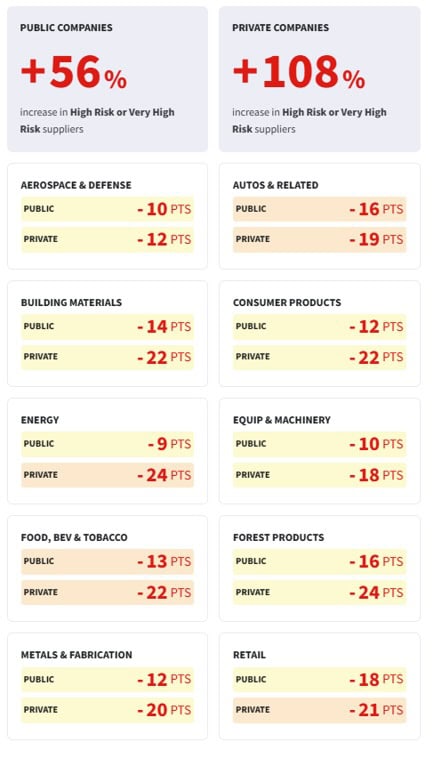
However, these resilience measures come at a cost. Rapid Ratings International, a supply chain risk intelligence firm, found that the number of suppliers rated as high or very high risk for weak financial health rose by 56% even when assuming that suppliers could only pass through half of the added cost. Consequently, many suppliers are struggling, and manufacturers may need to write checks to keep them operational, as late discoveries of supplier distress can leave manufacturers with few alternatives.
Moreover, supply chain disruptions can lead to significant financial losses for manufacturers. Assent Inc., a supply chain software firm, observed that manufacturers often have to retool entire factories, halt production, and destroy finished goods when they need to change a product's composition for regulatory reasons. This can result in significant cost increases and reduced working capital.
To mitigate these risks, companies may shift production to different locations, such as from Southeast Asia to Mexico, where labor costs are higher but unit costs are lower. While this may free up working capital and reduce exposure to other disruptions, it comes at the cost of increased labor expenses and reduced unit costs.
In summary, the landscape of supply chains is evolving rapidly, with companies facing the challenge of balancing the costs of resilience with the need to maintain profitability. Inventory build-ups, capital expenditures, and financing are all tools that can be employed to manage risk, but the financial implications can be significant. As geopolitical risks and supply shocks become more prevalent, companies must carefully weigh the costs and benefits of their resilience strategies.
Written by urgent.news from Global Finance's reporting — not their text. Machine-written — may contain errors; check the original before relying on it.