Stanford Scientists Intrigued by Method for Bringing Bleached Coral Back to Life
This could be a game changer. The post Stanford Scientists Intrigued by Method for Bringing Bleached Coral Back to Life appeared first on Futurism .
Climate change has caused widespread damage to coral reefs globally, leading to the phenomenon of "bleaching events" which are often perceived as the end for these vital ecosystems. This occurs when the living organisms expel microscopic symbiotic algae known as zooxanthellae that reside in their tissues and serve as a primary food source.
Although not entirely deceased, bleached coral becomes more vulnerable to diseases and starves to death. However, a serendipitous laboratory mishap has led Stanford University researchers to potentially discover an innovative method to revive bleached corals, as reported by Euronews. This significant breakthrough could possibly save numerous reefs from extinction due to climate change.
Over the past three decades, almost ten percent of the world's reefs have been lost, and bleaching events are becoming increasingly severe due to the intensifying impact of rising temperatures. As outlined in a paper published in the journal Science Advances, the researchers propose a novel strategy inspired by a 2025 discovery.
Back then, marine biologist and Stanford professor Steve Palumbi observed that a dead piece of coral, placed adjacent to a healthy one, began to regain its color. "While bleached corals may be dying, they are not dead yet," remarked Danny Collins, one of his collaborators. "The question we wanted to answer is, once a coral has bleached, what can we do?"
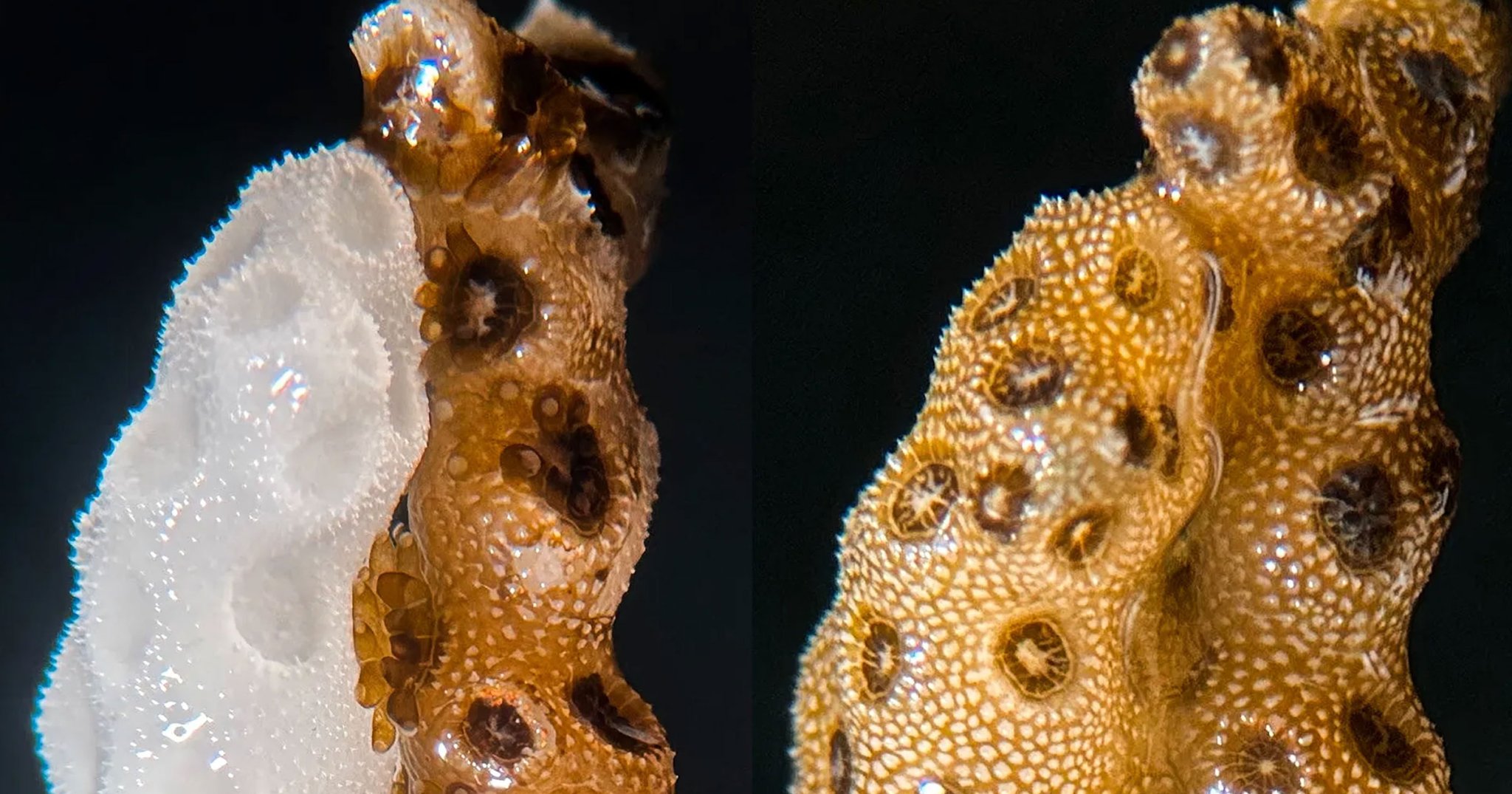
In a study involving ten coral fragments with bleached sections, half were in contact with healthy fragments while the rest were kept only a few millimeters away. The former resumed their vibrant color within seven weeks, while the latter perished due to starvation. After careful examination under a microscope, Palumbi and his team discovered that the corals had effectively fused, allowing the bleached fragments to absorb beneficial algae within just a week.
Palumbi stated that the algae "flood in and start dividing at the fastest rates seen in corals," roughly ten times faster than their natural pace. This research could prove instrumental in safeguarding coral reefs from perishing due to rising sea temperatures caused by climate change. "Bleached corals are often considered a lost cause because recovery after a heatwave is very slow, if it happens at all," noted Stanford professor and coauthor Fiorenza Micheli.
Nonetheless, it is still uncertain whether the newly discovered technique could be employed on a larger scale to rejuvenate bleached reefs. Furthermore, as Palumbi informed Euronews, the findings do not protect reefs from persistent rising ocean temperatures in the long run. "This is a recovery story," he emphasized. "It doesn’t blunt heatwaves; it just helps the aftermath.
There is still a huge need to reduce heatwaves and protect all of Earth’s life from rapid climate stress." Nevertheless, the findings could provide scientists with a tool to assist "coral gardens in surviving heatwaves more comprehensively," according to Palumbi.
Written by urgent.news from Futurism's reporting — not their text. Machine-written — may contain errors; check the original before relying on it.