O365 to O364: The day the world’s business lost a working day
When the world's most familiar digital workplace goes silent, the real question is not how quickly technology comes back, but how prepared businesses are to survive without it. Imagine waking up on a Friday morning, opening your laptop and discovering that Outlook is not responding, Microsoft Teams cannot connect, SharePoint is inaccessible and OneDrive has seemingly disappeared. Excel refuses to…
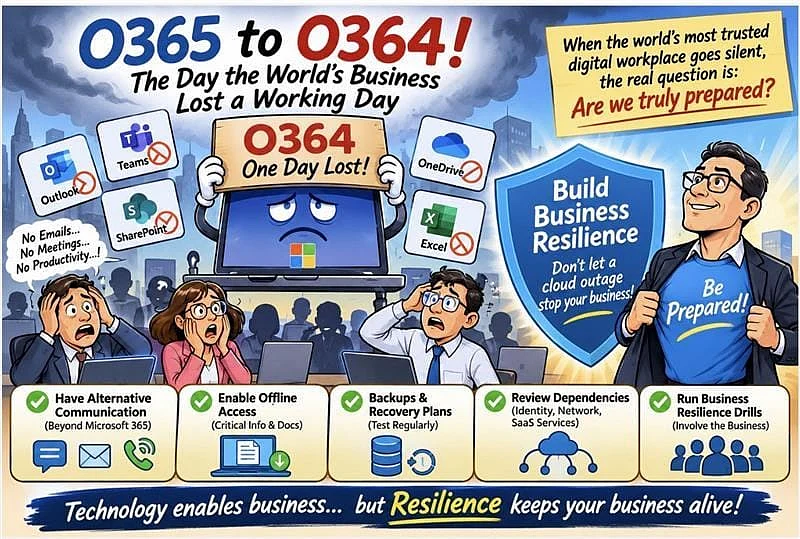
The world's most recognized digital workspace, when rendered silent, prompts a critical inquiry: not the speed of technology's recovery, but the preparedness of businesses to thrive without it. Picture waking up on a Friday, opening your laptop, and discovering Outlook unresponsive, Teams unable to connect, SharePoint inaccessible, and OneDrive seemingly vanished.
Excel defies cooperation, and essential calendar meetings transform into reminders of missed opportunities. Welcome to the day Microsoft O365 transformed into O364 – a day with one less productive day for globally connected businesses. Though a humorous notion, it underscores a serious concern about modern enterprise resilience: how intertwined the global economy is with a singular productivity ecosystem.
When the digital office unexpectedly takes a holiday, the CEO turns to the CIO, asking why no one is responding to emails. Teams meeting, messages, and official communication channels prove unavailable. For once, the CEO engages in face-to-face conversations, while the CFO assesses productivity losses, HR grapples with attendance recording, and sales teams scramble to reach customers.
Marketing even contemplates a global digital detox. Meanwhile, the IT service desk is inundated with tickets: Outlook, Teams, SharePoint, and the very productivity platform itself down. Ironically, no one can access the service desk system to check ticket statuses.
The humor masks a genuine enterprise risk. Microsoft 365 and similar SaaS platforms have become integral to daily business operations. Email, collaboration, document management, identity integration, workflow automation, and executive communications rely on interconnected cloud services. This convenience has revolutionized productivity, but it has also centralized operational dependencies.
A disruption affecting a widely used productivity ecosystem can trigger a chain reaction across organizations, suppliers, customers, and business partners. The repercussions extend beyond IT availability, impacting financial approvals, regulatory reporting, customer service, supply-chain coordination, business transactions, and executive decision-making.
The crucial distinction lies in the fact that cloud availability differs from business resilience. Organizations typically gauge service availability via contractual SLAs, yet how many have genuinely tested whether their critical business functions can persist when their primary productivity platform becomes unavailable? Business continuity cannot be designed on the assumption of perpetual technology availability.
CIOs, CISOs, CTOs, and business leaders should focus on five priorities: independent communication, offline business continuity, recovery and data protection, identity and integration resilience, and business-led resilience exercises involving business owners, not just IT teams. The ultimate measure of success is not the speed of IT service restoration but the organization's ability to protect customers, revenue, obligations, and reputation during disruption.
When services return, employees celebrate, resuming their usual routines. The CEO reminds everyone to ensure the next day's productivity compensates for today's losses. The CIO requests approval for business continuity investments. The CEO agrees, suggesting a discussion over their next Teams meeting. The real lesson: Microsoft 365 may support our digital workplace year-round, but a resilient business must be ready for the day its digital workplace takes an unexpected holiday.
Technology can facilitate business continuity, but it should never become the sole point of failure.
Written by urgent.news from Gulf News's reporting — not their text. Machine-written — may contain errors; check the original before relying on it.