Invisible Light Reveals How an Ancient King’s Shrine Looked 2,700 Years Ago
Learn how invisible light, X-rays, and years of patient detective work are letting visitors watch an ancient king’s shrine turn from plain stone to blue, red, and yellow.
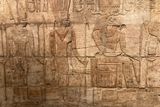
In 2013, a master's student aimed a modified camera flash at a 2,700-year-old stone shrine, revealing a glow in places invisible to the naked eye. The glow, captured by an infrared camera, was the result of blue paint that ancient artists reserved for gods and sacred imagery. This discovery sparked a three-decade-long investigation to uncover the original colors of the Shrine of King Taharqa, now displayed at the Ashmolean Museum in Britain.
King Taharqa's shrine, a 13-foot-square building, once stood in a temple at Kawa in Sudan before it arrived at the museum in 1936. Today, the shrine appears as bare stone, but the projection system used in the exhibit brings the faded sandstone to life with its original painted decoration. The shrine's walls began with a pink layer made from red pigment and white, followed by blue, red, and yellow paint.
The blue paint was particularly special, as it was Egyptian blue, the oldest known human-made pigment created by combining sand, limestone, and copper.
Researchers employed various techniques to uncover the shrine's colors, including microscope analysis of paint flecks, infrared imaging, X-ray mapping, and 3D scanning. These methods allowed the Ashmolean Museum to create a comprehensive picture of the shrine's original appearance. While some aspects of the display are informed reconstructions, the ultimate goal is to provide visitors with a deeper understanding and appreciation of the Shrine's art and archaeology.
The projection system, developed by Clay Interactive, fits the colors onto every carved line, while two short films in the exhibit trace the shrine's journey from construction to its discovery in the 1930s. Additionally, a film introduces King Taharqa and the gods depicted on the shrine's walls. As visitors press a button to illuminate the Shrine, they can witness the colors being painted across the walls, experiencing firsthand the wonder felt by those who first discovered the ancient artwork.
Written by urgent.news from Discover Magazine's reporting — not their text. Machine-written — may contain errors; check the original before relying on it.