Hackers Exploit PHP2Shell Flaws in Check Point Gateways to Deploy TSGA Backdoor and Wipe ESXi Files
An unknown threat actor has been observed targeting unpatched Check Point Security Gateways to obtain initial access via the PHP2Shell vulnerabilities and then a previously reported local privilege escalation flaw in Gaia OS to deploy a backdoor called TSGA. The activity, detailed by Check Point, began on October 30, 2026, and targeted Israeli organizations, with a broader follow-up wave
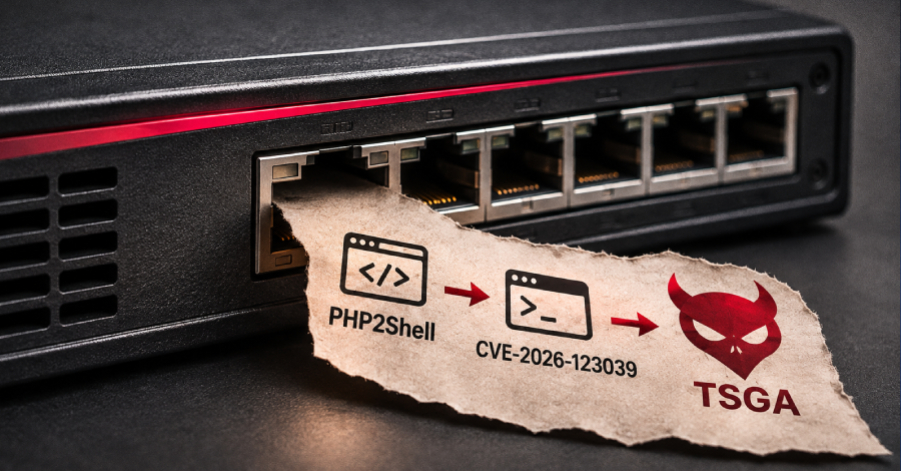
A previously unknown threat actor has been exploiting PHP2Shell vulnerabilities in unpatched Check Point Security Gateways to gain initial access, followed by a local privilege escalation flaw in Gaia OS to deploy a backdoor called TSGA. The campaign, starting on October 30, 2026, targeted Israeli organizations but later expanded to multiple countries and sectors.
Some organizations affected by the first wave also faced destructive actions, including the deployment of wiper malware. The attackers used PHP2Shell for initial access and DynamicCLI for privilege escalation, with CVE-2026-123039 (CVSS score: 7.8) enabling root-level command execution. They then deployed PHP web shells, the TSGA backdoor, and TSProxy networking component.
The TSGA backdoor is a Linux gateway implant that enables encrypted remote access, configuration theft, backup, and binary firewall-log tampering. The attackers also used TSGA to pivot to VMware ESXi hosts, deploy the destroy_v6 wiper, and leave politically themed notes. The attackers may have targeted some previously compromised organizations again, suggesting an opportunistic approach.
The backdoor and TSProxy are part of a toolkit called PhiliKit, attributed to a China-nexus cyber espionage group called Armory Castle. However, Check Point has not found sufficient evidence to confirm this attribution, and several scenarios remain possible.
Written by urgent.news from The Hacker News's reporting — not their text. Machine-written — may contain errors; check the original before relying on it.