Cheat sheet: the 180° rule of filmmaking and why your camera should never cross the line
Ever watched a TV scene where two characters suddenly seem to swap places mid-conversation? Here is how to use the 180° rule to avoid jarring cuts and maintain rock-solid visual continuity.
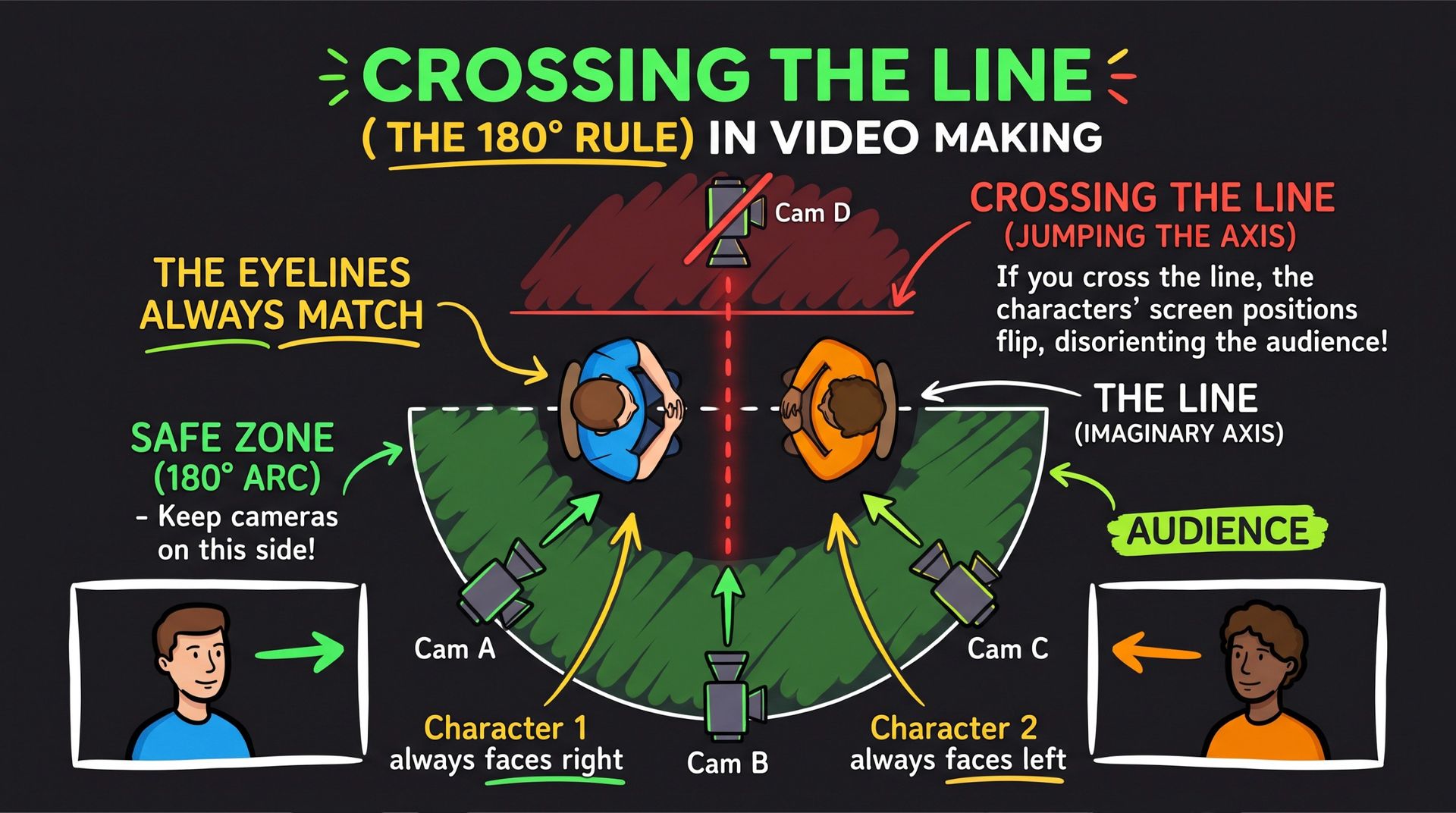
The 180-degree rule is a crucial aspect of filmmaking that maintains visual continuity in a scene and prevents audience confusion. It primarily applies when filming two characters or objects within the same space. To visualize the rule, imagine drawing a circle around the two characters, connecting them with an imaginary line. Camera placements should be on one side of this line for both characters, ensuring they remain on the same side of the frame and consistently look in the same direction during dialogue.
For example, if Character 1 is on the left of the frame and Character 2 is on the right, a camera can be positioned over Character 2's shoulder to observe the conversation. When Character 2 replies, the camera can switch to over Character 1's shoulder, looking toward Character 2. Crucially, the camera must never cross the imaginary line, moving from left to right or vice versa, as this would disrupt the continuity of the characters' positions and actions.
This rule is often employed in connecting shots, where the second shot is known as the reverse angle of the first, forming a complementary pair. The technique can also be applied when filming a single person, particularly if they are looking off-screen. In such cases, the subsequent shot is presumed to depict what the person is observing.
Reverse angles can reinforce height differences between subjects as well—e.g., a shot looking down on an animal can be matched with a reverse angle shot of what the animal is gazing at from ground level.
Additionally, when shooting a moving subject, the direction of movement should remain consistent across shots. For instance, if filming a family walking, the characters should appear to move from left to right across the screen uniformly. Changing the direction of movement would cause the viewer's natural assumption to be that they are now heading back to their starting point.
To avoid this, shoot from the same side of your subject throughout the footage, resisting the temptation to switch sides for a more intriguing perspective.
The 180-degree rule is sometimes referred to as the "crossing the line" rule, as the subject is heading along an imaginary line, and it is essential never to cross this line. This rule is also known as the 180° rule, and moving from in front of a subject to behind them without crossing their path is strictly prohibited. In some instances, however, crossing the line might be necessary, but there are two solutions to maintain visual clarity.
Firstly, continue recording as you cross the line, ensuring the moving subjects appear to head towards the camera and then move to the other side as they approach. Secondly, insert a cutaway shot—a brief visual break, like a shot of the crowd or a scoreboard—between the two shots to provide visual relief and facilitate the change in on-screen direction.
Written by urgent.news from Digital Camera World's reporting — not their text. Machine-written — may contain errors; check the original before relying on it.