AI helps conservators uncover lost details in William Merritt Chase painting
Newly restored work will go on show in new exhibition at New York's Parrish Art Museum
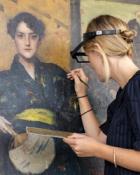
When William Merritt Chase's painting A Comfortable Corner (circa 1888) arrived at the conservation studio, numerous interventions by past conservators were evident. The Parrish Art Museum in Water Mill, New York, where the painting is part of its collection, enlisted the aid of artificial intelligence (AI) to restore the artwork. The restored piece will be showcased in the exhibition William Merritt Chase and Walter Granville-Smith: American Impressionists of the East End from November 14, 2026 to March 21, 2027.
The painting portrays a woman in a deep blue kimono, reclining within an elaborately decorated interior, while holding an uchiwa fan. Kaitlin Halloran, the museum's associate curator, notes that A Comfortable Corner is a significant work showcasing the 19th-century art and Japanese influences under Chase's artistic period. Two restorations, including a major one in the 1960s, had previously altered the painting's appearance.
These alterations included adding a heavy lining, retouching, blotchy inpainting, and uneven varnishes, which affected the texture and discoloration of the surface.
An early photograph of the painting, believed to have been taken before the 1960s restoration, revealed that more of the composition was previously visible. The 1960s restoration might have been done to make the painting fit a new stretcher or to cover damaged edges. The photograph also exposed missing details in the composition, such as a curl of hair beneath the sitter's ear, faded parts of a decorative screen, and overpainted delicate passages.
Conservator Suzanne Siano and her team used AI to create a composite image by combining the historical photograph with a color image of the painting. This composite showed the diverging areas, aiding the team in identifying sections that required more detailed examination. A critical discovery involved Chase's signature, which had become extremely faint, with some letters possibly obscured by overpaint.
Due to the abstract nature of Chase's signature, it may have been mistaken for carpet patterns during the earlier restoration.
Supported by a Bank of America grant, this project demonstrates both the potential and limitations of AI in conservation. While AI can expedite tasks and provide supplementary information, Siano emphasizes that conservation is carried out by highly skilled individuals who do not intend to replace AI with machines. She stresses that conservation involves a combination of science, art history, craft, manual skills, and artistry that AI cannot replicate.
Written by urgent.news from The Art Newspaper's reporting — not their text. Machine-written — may contain errors; check the original before relying on it.