This supernova impostor baffled astronomers for 15 years — until they found a hidden black hole feeding on an unstable star
A hidden black hole or neutron star companion to an unstable massive star is causing the system to erupt in light that mimics a supernova explosion.
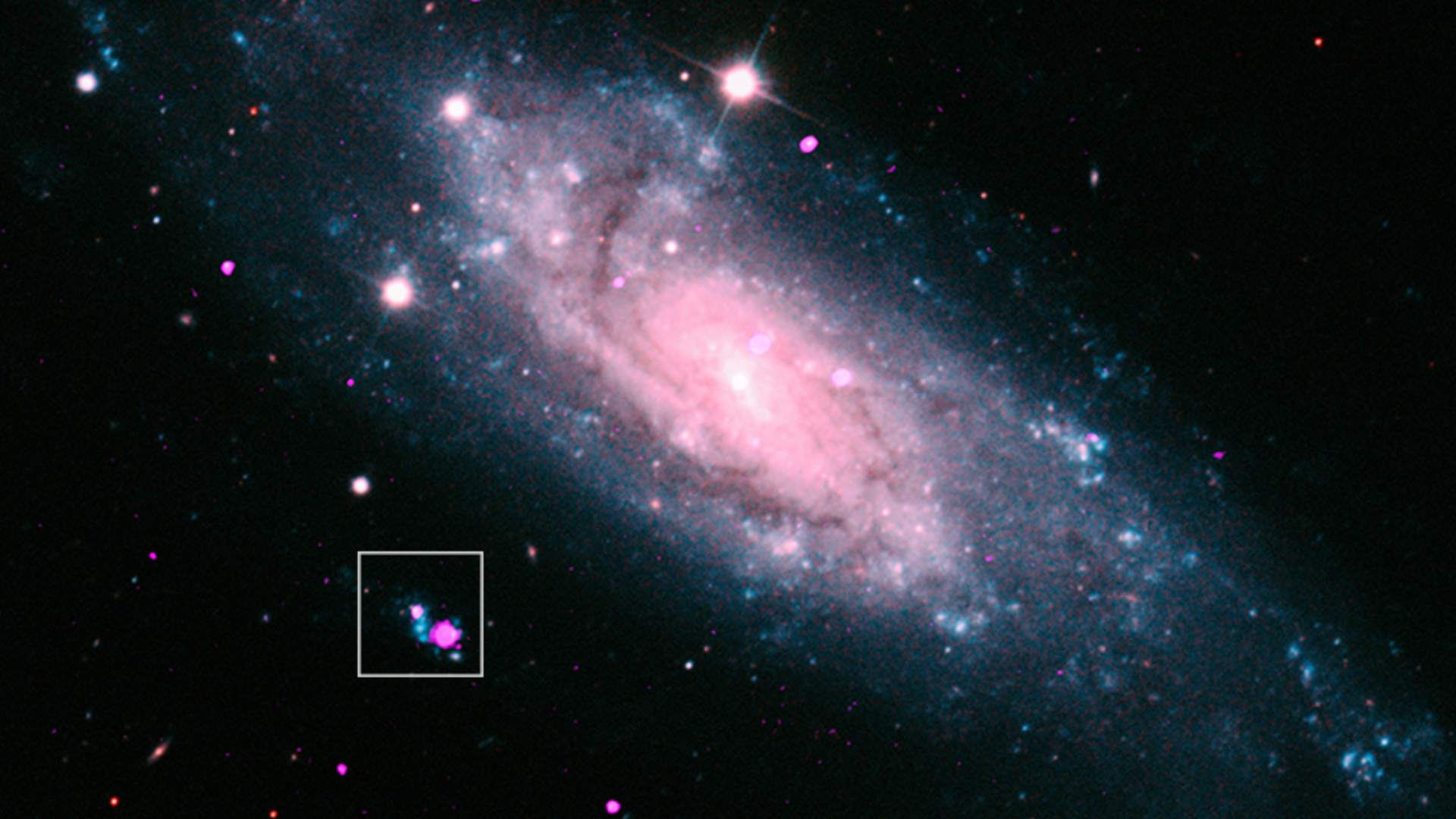
For 15 years, astronomers have puzzled over an object that repeatedly mimicked the appearance of a supernova. The source of this cosmic impostor, named AT 2016blu, is actually a luminous blue variable star, one of the most massive and luminous stars in the universe. These stars are highly unstable and experience mass loss as they eject material from their outer layers, but faking a supernova is not typical behavior.
Researchers from the University of Virginia in Charlottesville used NASA’s Chandra X-ray Observatory to observe AT 2016blu during an outburst in March 2026. By comparing Chandra images from 2001–02 with those taken in 2026, they discovered a powerful blast of X-rays coinciding with another false supernova outburst. This allowed them to determine the true nature of the object.
Chandra’s observations revealed the presence of an unseen companion to AT 2016blu, a compact, high-gravity object orbiting the luminous blue variable on a 113-day elliptical path. This companion is either a neutron star or a stellar-mass black hole, remnants of a parent star that underwent a real supernova explosion. Each time the compact object reaches the closest point in its orbit around the luminous blue variable, its strong gravitational pull pulls material from the unstable star, forming an accretion disk that swirls around the compact object and heats up to emit X-rays.
These X-ray emissions energize the surrounding cloud of material ejected by the luminous blue variable years earlier, causing it to glow brightly in visible light and giving the impression of a supernova. The research team believes that the bright optical flashes observed might be powered by periodic blasts of high-energy X-rays from the compact object.
The amount of material stolen by the compact object each year is immense, amounting to 440 billion trillion pounds, yet it is only a tiny fraction of the sun's mass and within the limits of what a neutron star can safely accrete.
Written by urgent.news from Space.com's reporting — not their text. Machine-written — may contain errors; check the original before relying on it.


