Global by default, local by design: What Indian founders learned about scaling across borders
At a Stripe roundtable at TechSparks 2026, leaders from edtech, commerce, fintech, and consumer hardware shared how to pick markets, localize smartly, and build the payments and compliance spine that makes expansion repeatable
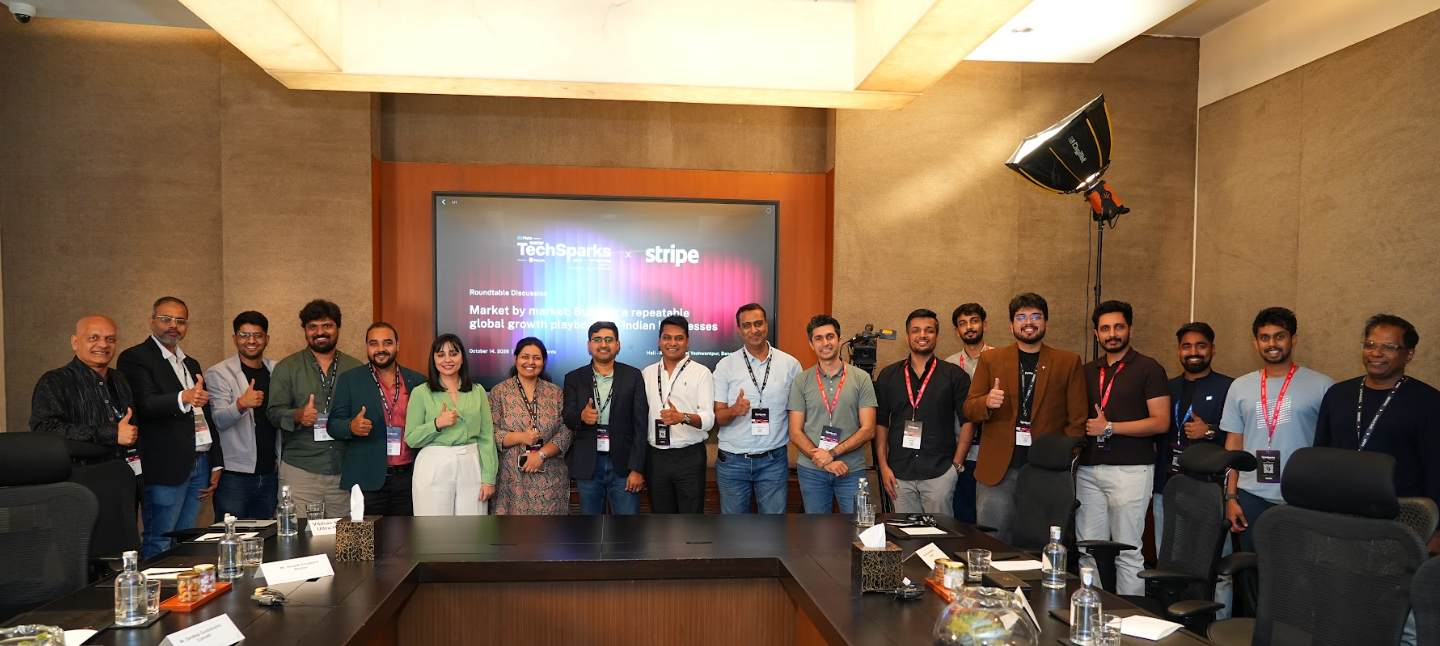
Indian businesses often start scaling globally by receiving their first sale from a distant customer, such as a shopper in Texas or a lead from Dubai. However, the challenge arises when determining whether subsequent markets will follow the same path or require a complete restart. This dilemma was the focus of a roundtable discussion at TechSparks 2026, YourStory's flagship event, where leaders from companies like Xoxoday, upGrad, Dodo Payments, Bhanzu, Borderless Access, and others gathered to share their experiences.
The conversation, moderated by Madanmohan Rao, Research Director, YourStory, and hosted by Manish Maheshwari, Managing Director, India, Stripe, emphasized the importance of validating demand before expanding internationally. Companies assess factors like customer acquisition cost, lifetime value, operational scalability, and the availability of reliable payment systems and local talent.
Establishing a foothold in a market where the same demand exists repeatedly is considered more valuable than a single large client in a single location.
To adapt to local markets, companies standardize their core functionalities while allowing flexibility in areas that directly impact the end-user experience, such as catalogs, curriculums, and preferred payment methods. Legal and regulatory requirements take precedence, followed by specific customer requests, such as red accents in China or tax-inclusive pricing in India. Pricing strategies require careful consideration, as demonstrated by a team that spent considerable time adjusting Indian price points for the US market.
Partnerships play a crucial role in successful global expansion. In the UAE, a government partnership facilitated the acceptance of credentials, while local payment partners improved affordability and attracted new customers. Maheshwari cautioned that payment failures or checkout issues can be misconstrued as demand failures, highlighting the significance of a seamless payment experience.
Payments were treated as a growth lever during the discussion. Maheshwari pointed out that payment failures can be mistaken for demand failures, emphasizing the need to prioritize payment success. Stripe's data revealed that 76% of customers prefer to pay in their own currency, and offering local payment methods and installment options for large purchases contributes to a positive customer experience.
Fraud control posed a balancing act, as stringent rules could deter genuine buyers. Tracking chargebacks, refunds, and failure rates by country helps identify inefficiencies, such as issues with one-time passwords under Indian authentication rules. Stripe's stance was that implementing a global stack from the outset is more cost-effective than attempting to retroactively fix issues later.
Compliance emerged as a critical aspect of global expansion. Revenue brings obligations, such as varying tax thresholds in US states, data regulations in Europe and India, and differing regulations surrounding text messaging. Founders shared stories of businesses shrinking overnight due to sudden regulatory changes, underscoring the importance of early compliance planning.
Technology, particularly artificial intelligence (AI), was identified as a tool to expedite the process. AI has significantly accelerated content localization, with human verification layers still in place to ensure accuracy. AI-powered sales bots handle lead qualification and reminders across time zones, boosting funnel performance by 20-25%. However, the discussion highlighted the need for robust cybersecurity measures, which were notably absent from the conversation.
The takeaway from the roundtable was that being global by default does not necessitate opening offices in every country. Successful scaling often involves localizing products and services based on market strengths. For example, one team adapted its curriculum and recruited instructors and sales staff in Japan, but the effort proved unsustainable as momentum faded within three months. The lesson was to concentrate on scaling where existing strengths lie and gradually expand.
The playbook for global expansion is still evolving. One notable gap identified was the expense and limited infrastructure for paying individuals abroad, such as teachers, from an Indian entity. As the conversation concluded, the consensus was that peer learning from those actively engaged in global expansion provided the most valuable insights. For Indian businesses, the path to global success is a disciplined, repeatable process, built one decision at a time.
Written by urgent.news from YourStory's reporting — not their text. Machine-written — may contain errors; check the original before relying on it.