Erstmals seit acht Jahren: Heißer Herbst - IG Metall setzt auf ganztägige Warnstreiks
Nach drei ergebnislosen Verhandlungsrunden eskaliert der Metall-Tarifkonflikt. Mit ganztägigen Warnstreiks will die IG Metall die Arbeitgeber zu engerer Zusammenarbeit zwingen.
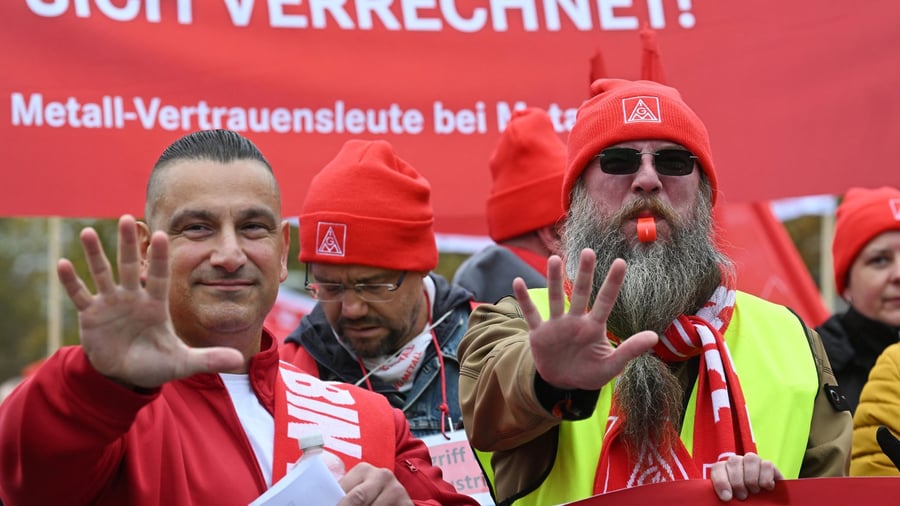
For the first time in eight years, daily strike actions have been scheduled across hundreds of German metal and electrical industry companies starting next week. IG Metall's executive board decided this during a meeting in Frankfurt, aiming to build pressure in tariff negotiations for around 3.7 million employees. It was initially unclear which specific companies would be affected, but the union plans to begin voting in workplaces on Friday.
If a simple majority votes for a 24-hour strike, production lines may come to a halt, likely in large firms where IG Metall has many members. They also want to ensure that all regions and industries, from auto to metal manufacturing, are affected. IG Metall applied this instrument of daily warning strikes for the first time in 2018, and used it again in the following four tariff rounds without this weapon.
In 2018, approximately 500,000 people from 250 companies went on strike for a whole day. This year, the management aims to specify a three-digit number of companies. Strike payments can be requested by union members to offset wage cuts. Daily warning strikes are the final stage before a general strike and an indefinite labor dispute.
So far, around 460,000 employees have staged hourly strikes as part of the current tariff negotiation, without receiving strike pay. Discussions have quickly revealed that, as in 2024, a pilot solution in tandem of two tariff regions is expected to be found. This time, the powerhouses of Baden-Württemberg and North Rhine-Westphalia are expected to bring the matter to heel.
Mutual participation has already been taken in the negotiations of the other region. The conflict over the core wage might receive a boost when Volkswagen's labor talks finally get going in January. Both sides claim they want the same thing: to stop the gradual de-industrialization of Germany and prevent associated job losses. The employers' association Gesamtmetall states that around 350,000 jobs have been lost in the core of German industry since 2019, with another 300,000 jobs already at risk due to underutilized facilities.
However, they have massive disagreements on the way out of the crisis. Gesamtmetall President Udo Dinglreiter states, "We share the same goal: to make investments profitable again and thus possible. We need a new operational instrument to secure investments, innovation, locations, and employment. But this model to rescue jobs and locations must be worked out at the negotiation table and will certainly not come about through daily strikes."
The daily strikes have caused additional damage and made investments in Germany less attractive. Union representatives offered a tariff procedure at the company level to support businesses planning investments by temporarily forgoing work, i.e., contributing voluntarily. In return, they demand binding promises regarding employment and want to be included in planning.
This is exactly what the employers have so far firmly rejected. They demand more automatic adjustments in the tariff agreement, i.e., reliefs when certain profit indicators are missed. They see decisions about investments as the core of entrepreneurial freedom. Union officials say they will not issue blank cheques for unilateral employer decisions and list further conditions: "Work hours are not a knob.
We have not forgotten the attacks on the 35-hour week. And there must be benefits for our members." In terms of mobilization for the daily strikes, IG Metall relies on the employers' offer, which they refer to as "indifferent", "no offer", or "brutal pay cut". IG Metall Chief Nadine Boguslawski says, "I get the impression that the employers want to exploit the crisis.
People should give not only their shirt but also their pants. That goes against our pride." A 1.3% increase in wages starting July 2028 and a one-time payment of a few hundred euros, only payable in economically healthy companies, will not nearly cover the expected loss of purchasing power due to inflation. Gesamtmetall's Chief Business Officer Oliver Zander also pointed out that the industry is not obliged to do so.
The union remains firm in its demand, saying, "A strike round without a future promise is not for us."
Written by urgent.news from Handelsblatt's reporting — not their text. Machine-written — may contain errors; check the original before relying on it.
This story
This is one outlet's version. Read the fullest account.