Erforschung des Weltraums: Esa: Grundstein für größte 3D-Karte des Kosmos gelegt
Die europäische Sonde „Euclid“ dringt in die Tiefen des Universums vor und soll Aufschluss über Dunkle Energie geben. Welche seltenen Phänomene das Teleskop bisher entdeckt hat.
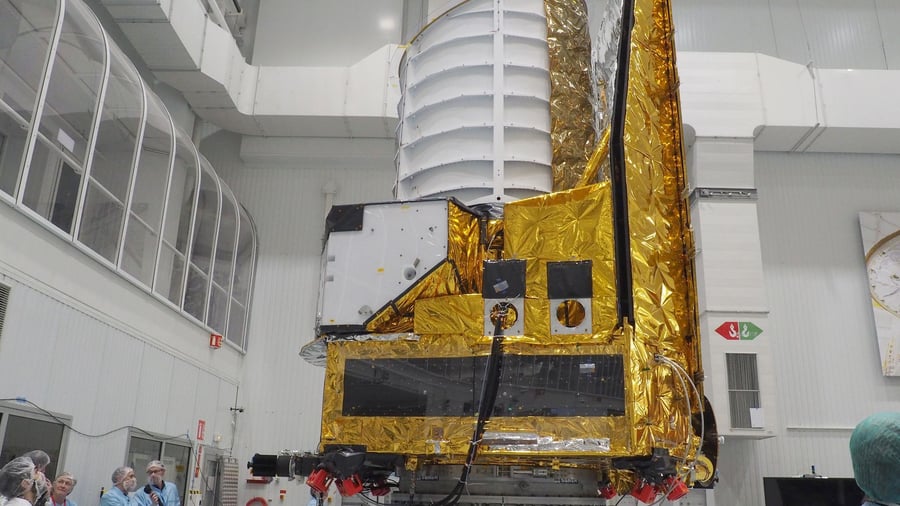
The European Space Agency (ESA) has unveiled the first comprehensive dataset from its Euclid space observatory, marking a significant milestone in humanity's exploration of the cosmos. The European space agency released a massive amount of observations from Euclid, which forms the basis for the largest 3D map of the universe created to date.
Euclid's scientific director, Carole Mundell, emphasized that these data are far more than stunning images, representing a major scientific breakthrough in our understanding of the cosmos.
Euclid has been in operation for 13 months, capturing data during its mission. The spacecraft, launched in the summer of 2023, is equipped with a high-resolution telescope and two instruments: a visible light camera (VIS) and a near-infrared instrument (NISP). These tools are designed to map the shapes of galaxies and help determine their distances.
The infrared instrument, developed by the Max-Planck-Institutes for Extraterrestrial Physics in Garching and the Max-Planck-Institutes for Astronomy in Heidelberg, is crucial for observing the distribution of galaxies over the past ten billion years.
The primary goal of Euclid is to shed light on the mysterious nature of dark matter and dark energy, which together make up a significant portion of the universe. These elusive components comprise about 95% of the cosmos, leaving only about 5% to be accounted for by galaxies and other known entities. Euclid has already imaged over a billion celestial objects, including 900 million galaxies and 60 million potential active galactic nuclei.
Its position in space, away from atmospheric interference, allows it to detect rare and distant objects such as galaxy clusters and gravitational lenses.
One of the most intriguing phenomena Euclid is expected to explore is gravitational lensing. The mass of a cluster of galaxies can distort the light from galaxies behind them, creating distorted arcs in the sky. By studying these gravitational lenses, scientists can gain insights into the expansion rate of the universe and the distribution of dark matter within galaxies.
"Gravitational lensing effects give us a unique glimpse into the dark universe, allowing us to weigh individual galaxies—including their invisible dark matter—and explore how the universe is expanding," explained Natalie Lines from the University of Portsmouth. "Ten years ago, we predicted that Euclid would revolutionize the field of strong gravitational lensing discoveries, and today, that day has finally arrived."
Written by urgent.news from Handelsblatt's reporting — not their text. Machine-written — may contain errors; check the original before relying on it.