Critical Red Hat Quay Flaw Lets Attackers Read and Overwrite All Private Container Images in a Registry
A critical flaw in Red Hat Quay allows an attacker who can access a Quay registry to read and overwrite private container images in every repository. Quay enables anonymous access by default, and while it is enabled, the attacker needs no account. When it is off, anyone with a valid account can still exploit the flaw, Red Hat said yesterday. The company has released fixed builds for eight Quay
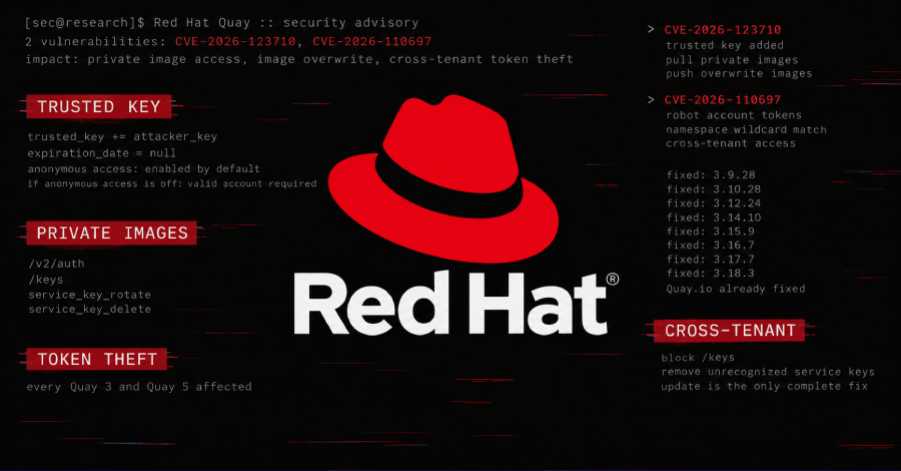
Red Hat Quay, a container registry service, recently disclosed two critical security flaws. The first, identified as CVE-2026-123710, enables an attacker to read and overwrite any private container image in the registry. By default, Quay allows anonymous access, meaning an attacker can exploit the flaw without needing an account.
Should anonymous access be disabled, any user with a valid account can exploit the vulnerability. Red Hat has since released fixed builds for eight Quay 3 branches to address this issue, which carries a CVSS score of 9.8.
The second flaw, CVE-2026-110697, allows a Quay user with the ability to create a namespace to steal robot account tokens from other tenants. These stolen tokens enable the attacker to read, push, or overwrite images belonging to other tenants. Moreover, the vulnerability exists due to an SQL LIKE pattern construction error that fails to properly escape wildcard characters.
Consequently, a namespace containing an underscore can match another tenant's namespace and expose their robot accounts. As with the first flaw, Red Hat has provided fixed builds for eight Quay 3 branches, with a CVSS score of 9.9, and disclosed both flaws simultaneously.
Both vulnerabilities are present in every Quay release since its first public commit, according to Dave O Connor, a Red Hat engineer who discovered them. Red Hat's advisory lists all Quay versions as affected, and the company's remediation guidance emphasizes that turning off anonymous access does not suffice to protect users. The suggested remediation steps include limiting namespace creation with underscores, rotating robot tokens for affected namespaces, and monitoring for anomalous pulls or pushes.
Despite the severity of these flaws, Red Hat's advisory for CVE-2026-110697 does not mention the latter vulnerability.
Written by urgent.news from The Hacker News's reporting — not their text. Machine-written — may contain errors; check the original before relying on it.
This story
This is one outlet's version. Read the fullest account.