Vietnamese businesses urged to study EFTA market requirements
Vietnam's VEFTA opens new export opportunities in four European markets, but businesses must navigate differing tariff preferences, rules of origin, and stringent product standards to fully benefit from the agreement.
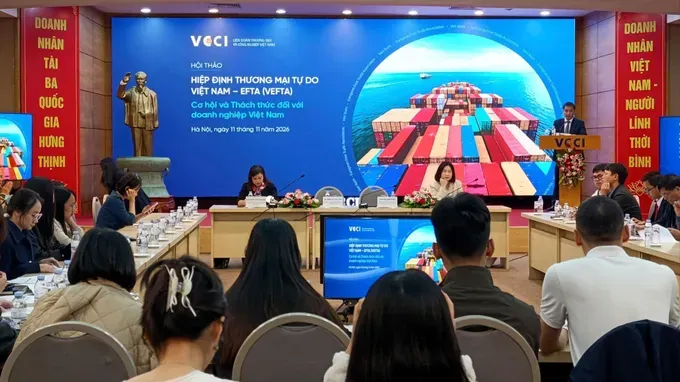
The Vietnam-EFTA Free Trade Agreement (VEFTA) opens new export avenues in four European markets, but businesses must meticulously study tariff differences, rules of origin, and strict product standards to maximize benefits. On November 11 in Hanoi, the Vietnam Chamber of Commerce and Industry, alongside relevant agencies, hosted a seminar titled "The Vietnam-EFTA Free Trade Agreement (VEFTA): Opportunities and Challenges for Vietnamese Businesses."
Nguyen Son Tra, representing the Ministry of Industry and Trade, revealed that VEFTA was signed after 14 years of negotiations, benefiting from access to high-purchasing-power European markets. As of 2025, total trade between Vietnam and EFTA surpassed US$1.9 billion, with Vietnam's exports totaling about US$405 million and imports exceeding US$1.5 billion.
Despite this growth, the trade balance remains skewed toward imports. The ministry noted that EFTA, not a customs union, requires businesses to individually study tariff schedules, import rules, and consumer demand of each member country. Market access conditions differ: Switzerland and Liechtenstein eliminate tariffs on around 40% of agricultural product categories, while Norway and Iceland offer 53% and 74%, respectively.
Tariff preferences commit EFTA to eliminating tariffs on 90% of tariff lines, covering 99.5% of Vietnam's imports by value. Switzerland and Liechtenstein will eliminate tariffs on about 85% of tariff lines, Norway on more than 90.7%, and Iceland on over 94%. However, businesses must ensure their goods meet applicable tariff schedules, rules of origin, direct consignment requirements, and valid certificates of origin.
Meeting product quality, safety, traceability, environmental protection, and social responsibility standards is also crucial. Dau Anh Tuan, VCCI Deputy Secretary-General, emphasized that businesses should focus on three key issues: varying tariff preferences, understanding that lower tariffs do not equate to lower standards, and overcoming non-tariff barriers, which often determine the success of entering EFTA markets.
Written by urgent.news from SGGP English Edition Business's reporting — not their text. Machine-written — may contain errors; check the original before relying on it.