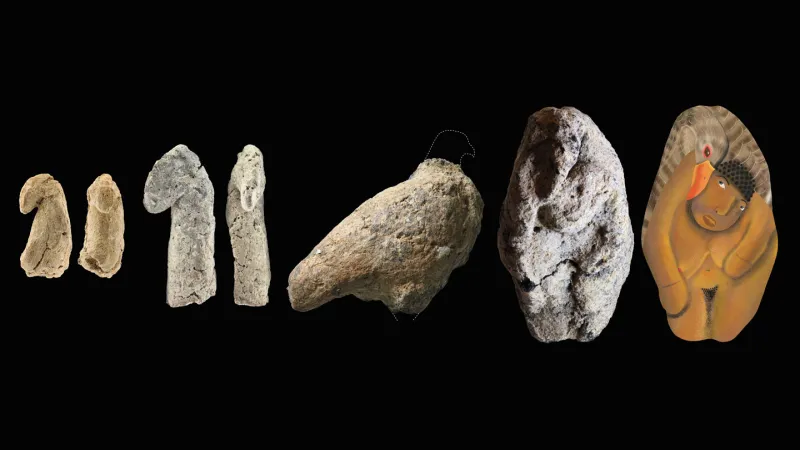
Stone Age children left fingerprints on ancient art projects
Natufian hunter-gatherers may have shown their kids how to sculpt clay, sets of preserved fingerprints suggest.
A rare Martian meteorite, Teghaza 001, has offered new insights into the red planet's ancient history, hinting at the possibility of ancient microbial life. Discovered in the Sahara Desert in Mali in 2022, it is one of the oldest Martian meteorites ever found, dating back 4.1 billion years. The meteorite contains significant amounts of manganese oxide, a compound commonly found on Earth as a result of microbial life.
Although this discovery does not definitively prove the existence of ancient Martian life, it piques scientists' interest. Carl Agee, director and curator at the University of New Mexico’s Institute of Meteoritics, described the meteorite as a Rosetta Stone for Mars, pointing out that it contained manganese oxide domains with high levels of a compound that rovers on Mars are searching for as an indication of habitable environments.
Teghaza 001 is composed of a single type of rock, making it unique compared to other Martian meteorites, and it represents an environment on Mars billions of years ago that was likely more Earth-like, with liquid water and warmer conditions.
Written by urgent.news from EarthSky's reporting — not their text. Machine-written — may contain errors; check the original before relying on it.