Sonia Gandhi accused of whitewashing India's history in memoir
NEW DELHI: India’s ruling Bharatiya Janata Party has accused opposition leader Sonia Gandhi of whitewashing historical wrongs by her Congress party in a memoir, sparking a new faceoff between the two sides ahead of key state elections.
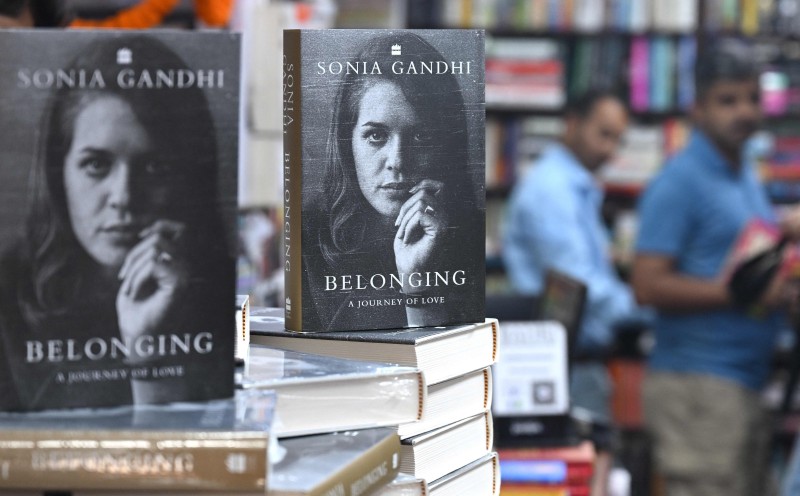
In her memoir, "Belonging: A Journey Of Love," Congress leader Sonia Gandhi discussed her exchange with her husband and then Prime Minister Rajiv Gandhi regarding the Shah Bano case. She questioned him about the accusations in newspapers that he was sacrificing Muslim women's interests and asked why he was allowing it to happen. Rajiv Gandhi explained that he was trying to address the issue fairly and defended women's rights. The conversation is included in the book which was released on Tuesday.
Sonia Gandhi also touched upon the RSS's supremacist beliefs and their political agenda, which aimed to replace constitutional ideals of equality, pluralism, and secularism with second-class citizenship for religious minorities in India. She mentioned that the Shah Bano case in 1985 was the first instance where this animosity between Hindus and Muslims arose during his tenure as Prime Minister.
The case involved a Muslim divorcee, Shah Bano, who sought maintenance from her husband who had remarried and thrown her out of their home. The court initially ruled in her favor, ordering a small maintenance payment, but her husband contested it on grounds of Muslim Personal Law.
Sonia Gandhi expressed her agitation over the issue, reading about it in newspapers and magazines. She argued with her husband about the papers accusing him of sacrificing Muslim women's interests and questioned him about the situation. He replied that he was attempting to deal with the complicated problem fairly and asked if she wouldn't defend women's rights.
The compromise Rajiv Gandhi accepted balanced religious beliefs and gender justice, giving Muslim women a fairer and more reasonable share than the initially awarded monthly amount of Rs 179.2.
However, the legal amendment that overturned the court's decision was criticized as a political move, with the BJP accusing the government of indulging in vote-bank politics and progressive liberals viewing it as a capitulation to conservative elements of Muslim society. In 2001, after seven changes of government, the Supreme Court upheld Rajiv's stance in the 1986 Muslim Women (Protection of Rights on Divorce) Act.
The source also mentions the Ram Janmabhoomi issue, where a dispute between Hindus and Muslims centered around a sixteenth-century mosque in Ayodhya. The BJP and the Vishwa Hindu Parishad (VHP) launched a movement to build a temple on the site, which had previously been the epicenter of the conflict. Skirmishes and violence between the communities intensified after the Shah Bano decision, further polarizing Hindu-Muslim relations.
Written by urgent.news from The Economic Times's reporting — not their text. Machine-written — may contain errors; check the original before relying on it.
This story
This is one outlet's version. Read the fullest account.
- Sonia Gandhi questioned Rajiv on Shah Bano case economictimes.indiatimes.com
- Sonia Gandhi accused of whitewashing India's history in memoir brecorder.com
- Penguin was 'uneasy' with criticism of govt in my memoir: Sonia Gandhi business-standard.com