Palace of Justice: Revisionism, Post-Truth, and the Battle for Colombia’s History
On Nov. 6, 1985, 34 members of the M-19 guerrilla movement stormed the Palace of Justice in central Bogota, Colombia’s capital, attempting to subject President Belisario Betancur to a political trial. The operation culminated in 33 insurgents losing their lives, alongside 11 members of the state security forces and 43 civilians. Misreading the prevailing political […]
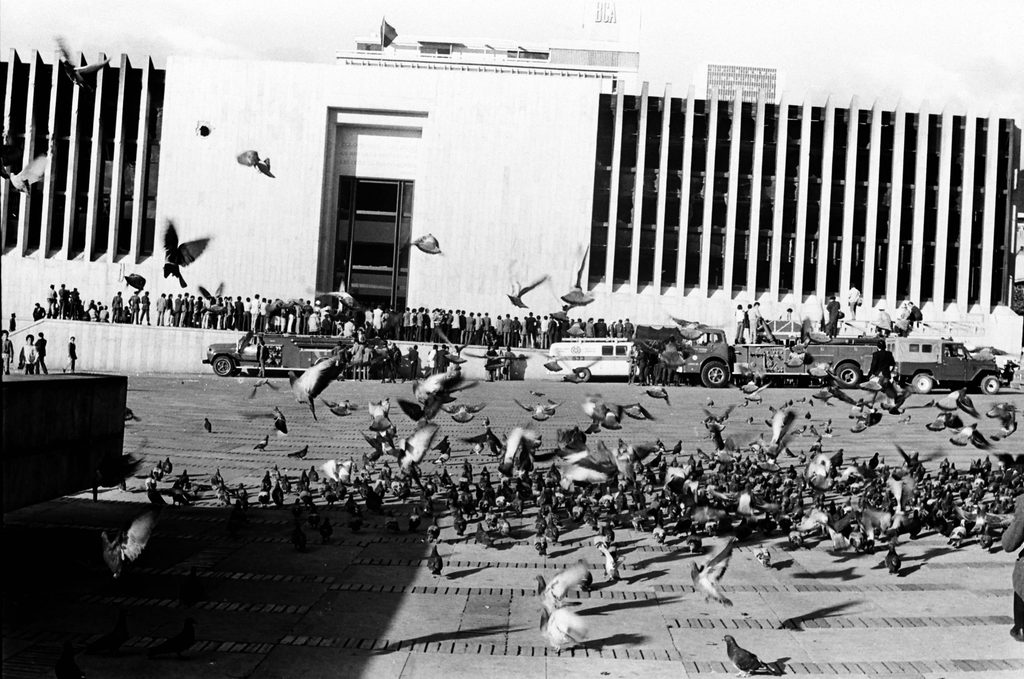
The Palace of Justice siege in Colombia on November 6, 1985, saw 34 M-19 guerrillas storm the seat of government, resulting in 33 insurgent deaths, 11 security force losses, and 43 civilian casualties. The M-19 failed to anticipate the military’s willingness to destroy them, marking a disastrous strategic miscalculation. However, 41 years later, the narrative surrounding the retaking of the Palace remains deeply contested within Colombia’s collective memory.
This debate was recently reignited by the Netflix original series Palacio, which has sparked discussions on state responsibility, operational impunity, and unverified claims about the Medellin Cartel’s alleged financing of the siege. Rather than providing an objective platform for truth, the institutional narrative promoted by state memory entities continues to weaponize historical facts to influence democratic discourse.
To accurately account for the events, two undeniable truths must be acknowledged: the M-19’s reckless political and terrorist actions that endangered hundreds of lives, and the Colombian state’s systematic and deliberate crimes during and after the retaking of the building. Intelligence reports had previously identified signs of the insurgent plan, yet state security forces and metal detectors were inexplicably removed, leaving the Palace guarded by private personnel.
During the military counter-offensive, protecting civilian lives took a backseat to destroying the guerrilla command. Trapped civilians and Supreme Court President Alfonso Reyes Echandia made desperate pleas for a ceasefire, but these were ignored. Following the military breach, survivors were systematically tortured, including Orlando Arrechea, Eduardo Matson, Yolanda Santo Domingo, Magalis Maria Arevalo, and Hector Heli Rubiano.
Notable figures like auxiliary magistrate Carlos Uran Rojas and surrendering guerrillas Irma Franco and Eduardo Almonacid were also subjected to extrajudicial executions. At least 10 civilians and one insurgent were transported to Casa del Florero, followed by torture, execution, and burial in unmarked graves. The crime scene was altered, human remains mishandled, and defense attorney Eduardo Umaña Mendoza assassinated in 1998 for advocating victim families' rights.
The debate surrounding the Palace of Justice reflects a broader struggle over public memory, highlighting the difference between professional historical revision and political revisionism. Professional revision relies on new documentation, rigorous methodologies, and empirical falsifiability, while political revision starts with an ideological conclusion and suppresses or selects evidence to align with it.
In Colombia, this institutional capture is evident in the Centro Nacional de Memoria Historica (CNMH). Established in 2011, the center initially aimed to guarantee victims' rights to memory. However, under conservative leadership, its institutional posture shifted significantly. This transformation reorients state memory by focusing on external terrorist practices while ignoring systemic socio-political causes, downplaying extrajudicial executions, forced disappearances, and torture by public forces, and discrediting independent truth commissions and international human rights tribunals.
This pattern of rewriting history is not unique to Colombia; it is a core element of contemporary radical-right governance worldwide. Similar strategies are employed in Argentina, Chile, and Germany, where political entities with right-wing leanings question established narratives of state violence, downplay or defend military repression as a "just war," and reduce funding for memory archives.
Written by urgent.news from Colombia One's reporting — not their text. Machine-written — may contain errors; check the original before relying on it.