New tech lets you control your smartwatch by touching your arm
Researchers have developed technology that turns a smartwatch user's forearm into a trackpad.
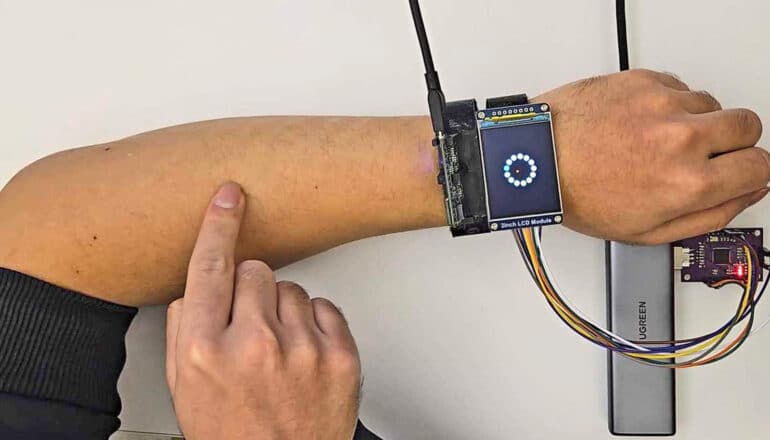
Researchers have created technology that transforms a smartwatch user's forearm into a trackpad, allowing them to scroll, zoom, and click on icons, much like their laptop counterparts. The system functions through a radar that tracks the user's finger movements and pressure on their skin, offering the same level of force-touch precision as laptop trackpads.
Assistant Professor of Computer Science at North Carolina State University, Chenhan Xu, explains that the goal was to develop a small, wearable technology providing familiar interactive control for users, as smartwatch screens are too small for everyday touch interactions. EpiPad, the name of this technology, consists of a compact millimeter-wave radar worn on a wristband that reads the tiny indentations fingertips make upon pressing the skin, thereby tracking multiple fingers and the pressure each one applies.
Users must perform a brief series of standard actions when wearing the EpiPad wristband to allow the technology to adapt to their actions, which takes less than four minutes. The current prototype resembles a wristband with a protruding circuit board, but the technology could be integrated into conventional smartwatch devices with a less conspicuous design.
The sensor array responsible for monitoring motion and force-touch is only 5 millimeters by 4 millimeters in size. During proof-of-concept testing, 20 study participants were involved in various experiments to evaluate EpiPad's accuracy and ease of use. EpiPad excelled in on-screen tracking accuracy, input gesture recognition, and force-touch, outperforming traditional touch screens, tilt cursors, and other methods.
Xu believes this technology could enable future smartwatches and screenless wearables, such as AI glasses, to use the wearer's own skin as a full touch surface. The functional components of EpiPad, including the radar sensor array, are relatively inexpensive, with costs potentially dropping below $10 if scaled up for widespread use in wearable devices.
The researchers are open to collaborating with industry partners to explore the incorporation of this technology into next-generation devices, as the trend of creating smaller and smaller wearable electronics may make having an easy and reliable user interaction feature particularly attractive.
Written by urgent.news from Futurity's reporting — not their text. Machine-written — may contain errors; check the original before relying on it.