MatterSeek AI: A Guide to Reverse Materials Design and Property Prediction
Learn about MatterSeek-New-Materials-Reverse-Design, including its features, technical architecture, applications, inputs, outputs, and limitations.
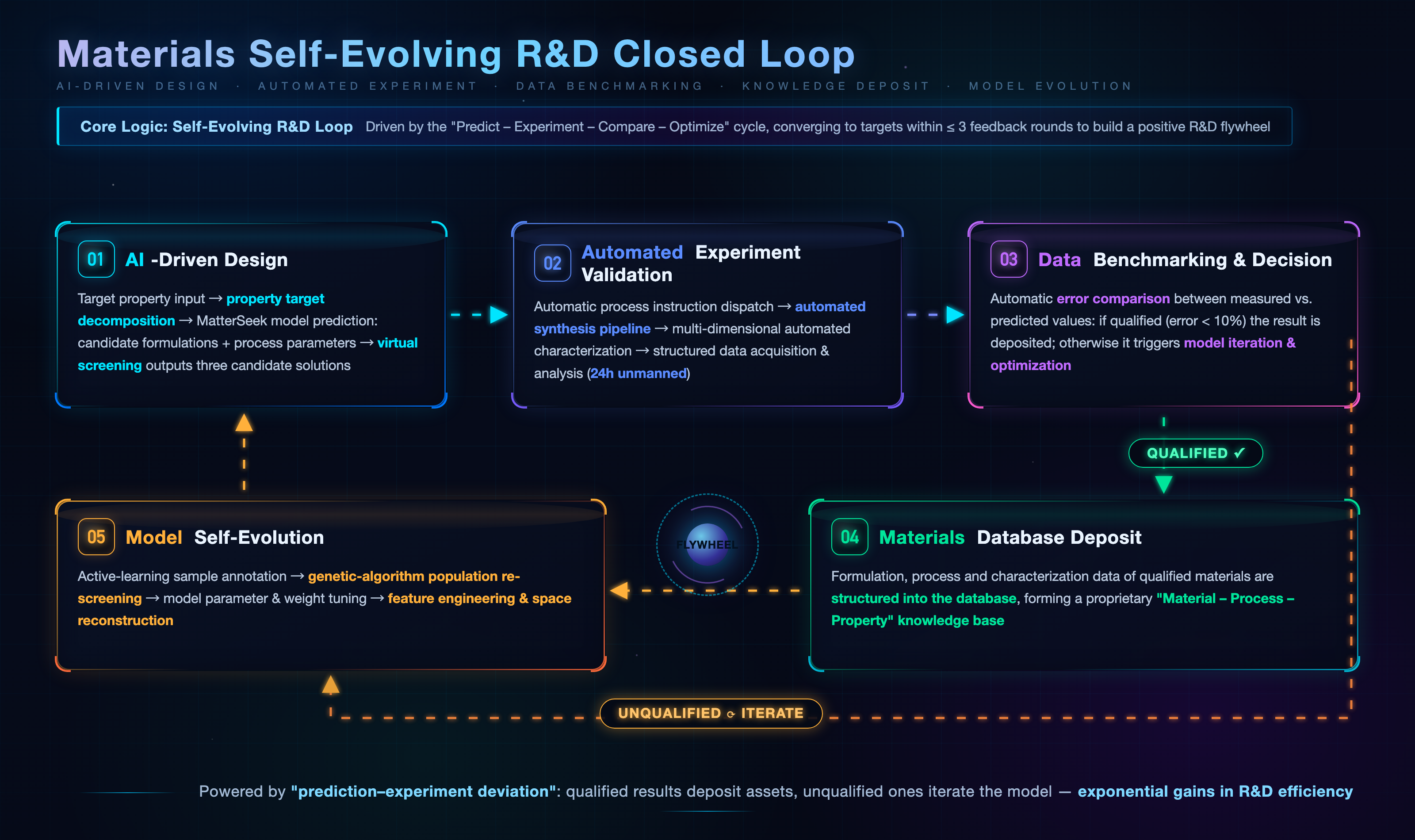
MatterSeek-New-Materials-Reverse-Design is a reverse-design feature of Yuyao Technology's MatterSeek platform for predicting and designing materials. Users input desired properties and elemental limits, and the service suggests compositions, structures, and processing conditions. YuyaoTechnology maintains the service, which is currently in beta.
The README recommends using the predictions to prioritize experiments, followed by offline validation. MatterSeek is described as suitable for screening materials against target properties, exploring composition and element constraints, and generating ranked candidates for multi-objective design. It also supports forward property prediction from composition formulas or other inputs, and proposing synthesis conditions like sintering or annealing parameters.
The platform covers 17 materials domains and 192 target properties, including superconductivity, catalysis, optics, mechanics, thermoelectrics, and crystal structure. However, predictions are meant to support experiment prioritization, not fully replace laboratory validation. Offline validation is advised before scale-up, especially for critical or regulated applications. The coverage is limited by the current taxonomy of domains and properties.
The README reports evaluation on a held-out experimental test set within YuyaoTechnology's own corpus, but no numerical benchmark results or public peer comparisons are provided. The platform is described as a hierarchical neural network (HNN) with a shared backbone learning cross-domain representations from 1,035 material descriptors, and 192 expert sub-models grouped into 17 domains.
Physics-informed regularization applies constraints as soft penalties during training. The model undergoes two stages: self-supervised masked-fingerprint or structure reconstruction on composition-structure-property records, followed by domain fine-tuning with physics-informed loss and active-learning feedback.
Training data consists of several million records, mostly proprietary high-throughput experimental measurements and curated literature values, supplemented by DFT-derivable structural data. Exact technical specifications like parameter count or hardware requirements are not disclosed. The model card does not provide a documented local inference interface for this materials-design service.
Inputs include natural-language chemistry instructions, property targets, elemental constraints, and composition formulas. Users can select elements and filter composition ranges using an interactive periodic table. Outputs include predicted properties with uncertainty bounds, candidate compositions, crystal structures, processing windows, and ranked experiment proposals. Results are visualized multidimensionally. The README does not specify a machine-readable output schema.
Frequently asked questions address the service's purpose, domains covered, input types, output results, limitations of predictions compared to laboratory validation, availability of public benchmarks or peer comparisons, and lack of a local code example or API schema.
Written by urgent.news from HackerNoon's reporting — not their text. Machine-written — may contain errors; check the original before relying on it.