I tested the two most popular DNS servers head-to-head, and it wasn't a competition
Cloudflare and Google are pretty close in speed, but not in much else
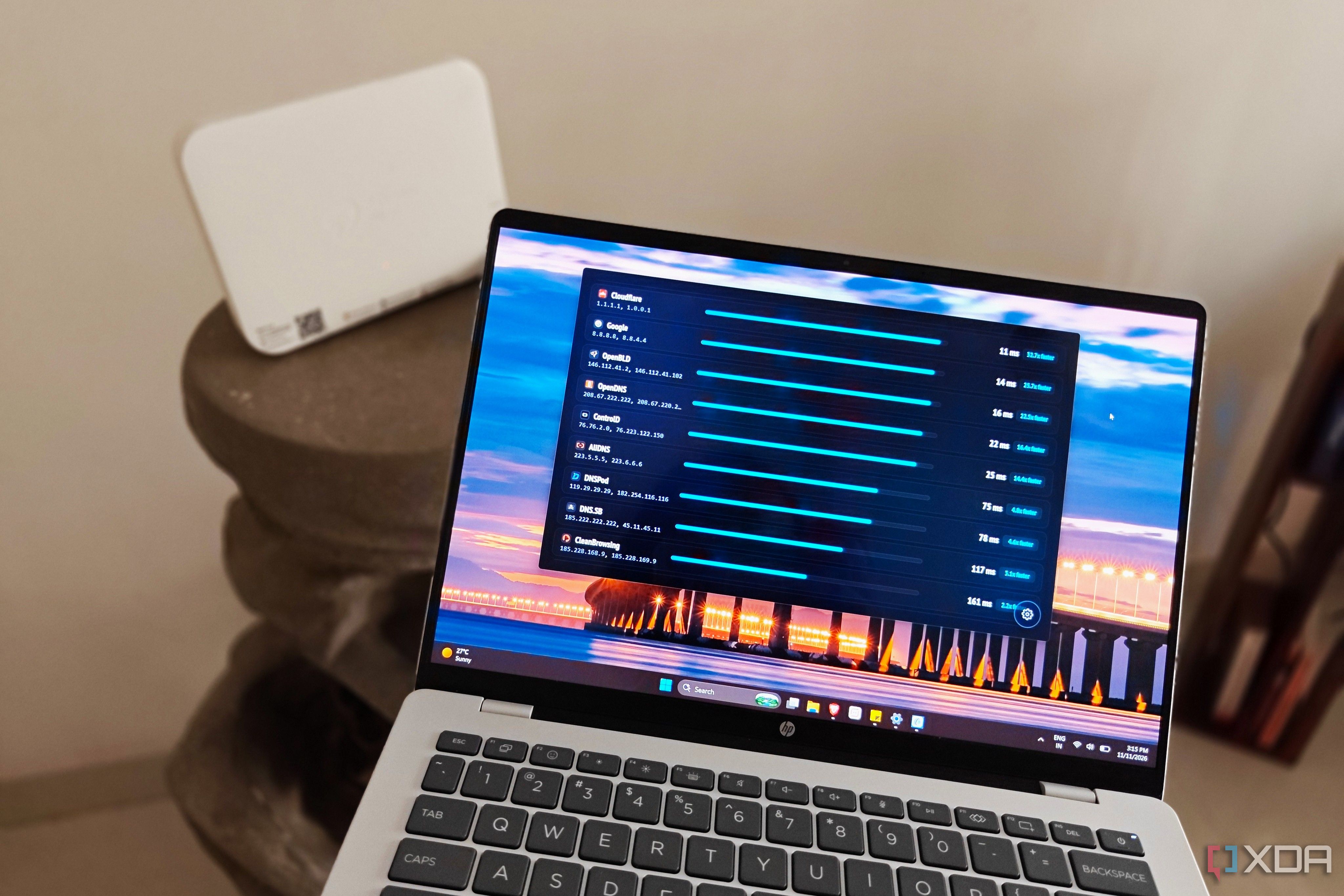
After experimenting with various router settings, most individuals never consider altering their default DNS servers. These servers provided by your Internet Service Provider (ISP) are often slower than other free or paid alternatives. This sluggishness can affect the overall performance of your network, as well as lower your privacy since the ISP can monitor every domain you visit.
Many suggest replacing the default DNS with Google or Cloudflare DNS services, but it is not clear which one performs better overall. To determine this, I conducted tests on my system using both Ethernet and Wi-Fi connections. The real-world performance of Google and Cloudflare DNS servers is more telling than online tools, which may not accurately represent actual usage.
I utilized a Windows app, DNS Speed Tester, available on the Microsoft Store, for a more accurate comparison. In terms of speed, Cloudflare outperformed Google, although the difference was minimal (2/4ms versus 9/10ms). The gap between the two is not substantial, as anything below 20ms is considered excellent. Therefore, switching to either Google or Cloudflare DNS should alleviate any perceived slowness when browsing social media, streaming Netflix, or connecting to game servers.
However, the decision between the two services goes beyond speed. Privacy is a significant factor for many users. Cloudflare explicitly states that they delete most DNS query data within 25 hours, do not sell data to advertisers, and are audited by a Big 4 firm to review their privacy practices. On the other hand, Google retains some DNS query data for up to 48 hours, keeps other non-personally identifiable data, and anonymizes IP addresses to city or region level only.
While Google does not use your data for advertising, it lacks the same level of transparency as Cloudflare. Additionally, Cloudflare offers several DNS server options, allowing users to control the extent of web exposure on their network. Google's servers, on the other hand, do not block any content, but Cloudflare's 1.1.1.2 and 1.1.1.3 servers provide DNS filtering for enhanced control over malicious, phishing, and malicious domains.
For parents, Cloudflare's dedicated apps for Windows, macOS, Linux, Android, and iOS facilitate easy toggling of DNS settings and additional content filtering. Although other DNS servers exist, Google and Cloudflare are the most well-known, both offering reliable and fast services. In my experience, Cloudflare emerged as the fastest resolver, while Google was close behind.
However, considering privacy and control, Cloudflare is the clear winner, offering more stringent and transparent policies and additional features through its dedicated apps.
Written by urgent.news from XDA Developers's reporting — not their text. Machine-written — may contain errors; check the original before relying on it.