Energie: Das höchste Windrad der Welt überragt den Eiffelturm und steht in Deutschland – 100 weitere könnten folgen
In Schipkau in der Lausitz steht das höchste Windrad der Welt. Schon ist der erste Park mit mehreren Rekordanlagen in Planung. Dabei steht die Technologie noch am Anfang.
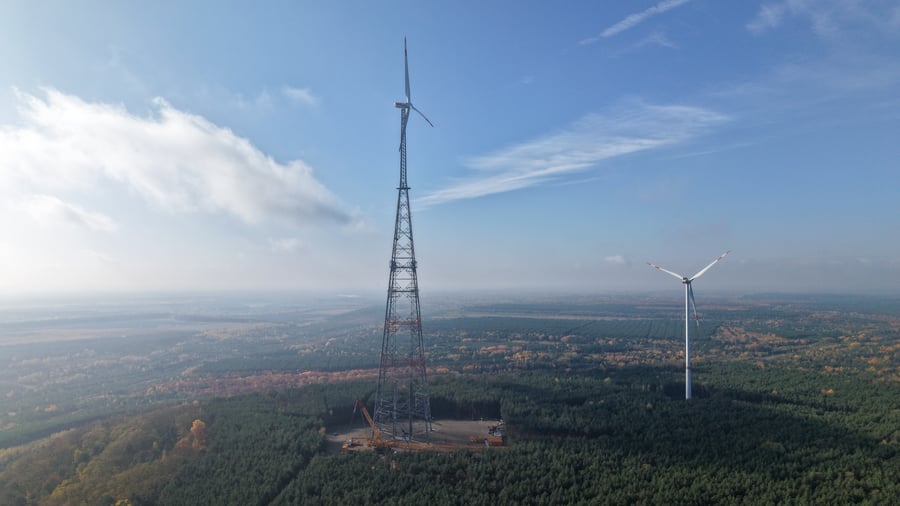
In the quiet Lausitz region, nestled between Dresden and Berlin, lies the small town of Schipkau. Here, the world's tallest wind turbine proudly stands in a former lignite mining area. The colossal 365-meter structure even outshines the iconic Eiffel Tower in Paris, which stands at 330 meters. The surrounding wind turbines appear almost quaint in comparison, towering 150 to 200 meters high.
The height of the tower is expected to be connected to the power grid in the coming days, and visitors from both within and outside Germany have been flocking to the eastern German town to marvel at the record-breaking achievement. Jochen Großmann, the engineer and founder of Gicon, the company behind the tower, claims that the turbine can generate twice the energy of a traditional onshore turbine using the same rotor diameter.
With over 15 years of research behind its idea, Gicon has successfully built a turbine weighing more than 2000 tons and consisting of 22,000 individual parts. Großmann proudly states that this is an engineering marvel. If the projections hold true, the height-based wind power could provide a significant boost to the energy transition.
Compared to traditional wind turbines, height-based wind power offers several advantages: at greater heights, the turbines gather significantly more and more predictable wind energy. Scientists and companies worldwide have been trying for years to harness higher altitudes for energy generation, through wind dragons or mobile air-wing wind systems.
However, so far no breakthrough has been achieved. However, the height-based wind power promises even double the energy output of traditional land-based turbines and stands firmly on all four legs. The potential is considered significant by the Federal Agency for Innovation (Sprind): "Height-based wind turbines could be built as second floors in existing wind farms on existing land areas, thereby increasing yields."
Germany alone could realize a potential of around 4000 height-based wind turbines in existing wind farms. The Sprind has funded the Schipkau project with 25 million euros. To reach a height of 365 meters, the Dresden team developed a special telescop system with Gicon. The facility is essentially built from two towers: an inner and an outer one.
The turbine sits on the inner tower. After the outer framework was completed, the inner steel structure was lifted onto the outer framework using a hydraulic lifting system. There are no cranes for such heights, so the height-based wind turbine is its own crane. With a rated power of 3.8 megawatts, the height-based wind turbine could produce electricity for up to 7500 households.
Future facilities are also expected to be equipped with the latest turbine generation, with a capacity of seven megawatts, promises Gicon. "This technology will be used on a large scale in the coming years, thereby making a substantial contribution to Germany's energy security," says Sprind Innovation Manager Martin Chaumet during the project presentation.
Costs are four times higher than for a "normal" wind turbine. Gicon already plans the next five height-based wind turbines, with series production expected by 2030. "We already have letters of intent for the construction of 100 more height-based wind turbines across Germany," says Großmann to the Handelsblatt. Even the distributor Enercity, responsible for the technical and commercial operation of the height-based wind turbine in Schipkau, sees great potential in the technology.
However, "now it depends on how big the yield increase will be and to what extent the costs can be reduced - because in the end, a project must always be economically viable," says Thomas Oetjen, deputy head of operations at Enercity Erneuerbare, Handelsblatt. The energy industry is watching the project closely. After all, Gicon promises energy yields comparable to offshore wind power, "essentially on land," says Großmann.
As expected, the costs are on par with offshore wind power. They are roughly four times higher than those of a "normal" wind turbine in 2025. "If we take into account the increased yield at 300 meters height at this location, the costs per kilowatt would have to fall by about 60 percent to achieve comparable operation costs to today's turbines," says Christoph Winkler, Team Leader "Global Energy Pathways" at the Fraunhofer Institute for Solar Energy Systems (ISE).
The cost of electricity from height-based wind power, also known as Levelized Cost of Electricity (LCOE), describes the total costs over the lifetime of a plant in relation to the generated electricity amount. According to the Fraunhofer Institute for Solar Energy Systems (ISE), the LCOE for land-based wind energy currently ranges between 4.3 and 9.2 cents per kilowatt-hour.
For offshore wind power, the LCOE is between 5.5 and 10.3 cents per kilowatt-hour. The record-breaking height also brings a potential acceptance problem: "To be analyzed would be how the much more visible height-based wind turbines, with their nearly double height and special turbine design, would affect public acceptance, especially in regions perceived as beautiful by nature," says Winkler. The acceptance of wind power can always be a problem.
Written by urgent.news from Handelsblatt's reporting — not their text. Machine-written — may contain errors; check the original before relying on it.