Cambodia’s mangrove forests offer vital refuge for threatened wildlife, 7-year study finds
Cambodia’s mangrove forests and the wetlands associated with them provide critical refuge for several threatened and elusive species, including fishing cats and hairy‑nosed otters, according to a recent study. Researchers from the Phnom Penh-based private company Fishing Cat Ecological Enterprise (FCEE) deployed camera traps across 156 coastal and riverine mangrove sites within the Peam Krasop […]
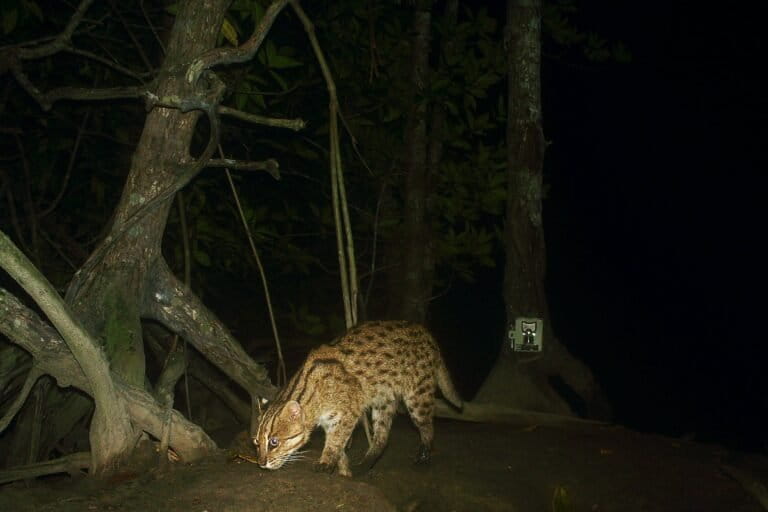
A recent seven-year study conducted by Fishing Cat Ecological Enterprise (FCEE) has revealed that Cambodia's mangrove forests and associated wetlands play a crucial role as a refuge for several threatened and elusive species. The research, conducted in the Peam Krasop Wildlife Sanctuary and Koh Kapik Ramsar site, both part of Cambodia's largest mangrove area, utilized camera traps installed at 156 different coastal and riverine mangrove sites between 2017 and 2023.
The study documented the presence of various threatened species within the mangrove forests, including fishing cats (Prionailurus viverrinus), smooth-coated otters (Lutra perspicillata), leopard cats (Prionailurus bengalensis), hairy-nosed otters (Lutra sumatrana), and large-spotted civets (Viverra megaspila). The footage revealed that the mangroves provided a rich habitat for these species, with some favoring the areas, such as hairy-nosed otters by rivers and large-spotted civets in swamp forests dominated by paperbark trees (Melaleuca spp.).
However, the study also found that four threatened species experienced declines over the seven-year period, namely the endangered long-tailed macaque (Macaca fascicularis), large-spotted civet, and the vulnerable fishing cat and smooth-coated otter. Only the adaptable common palm civet (Paradoxurus hermaphroditus) showed signs of an increase in population.
The researchers emphasized the importance of protecting not only the mangrove forests but also the surrounding Melaleuca forests, which are vital for the endangered large-spotted civet, and the riverine mixed mangroves, which are critical for the endangered hairy-nosed otter, the rarest otter species. The critically endangered Sunda pangolin (Manis javanica) and the endangered hairy-nosed otter remained challenging to detect due to their elusive nature.
Written by urgent.news from Mongabay's reporting — not their text. Machine-written — may contain errors; check the original before relying on it.