Your MRR Has a Ceiling, and Churn Sets It
Monthly churn sets a hard ceiling on a SaaS's MRR: new MRR divided by churn rate. The formula, how fast you reach it, and how to raise it.
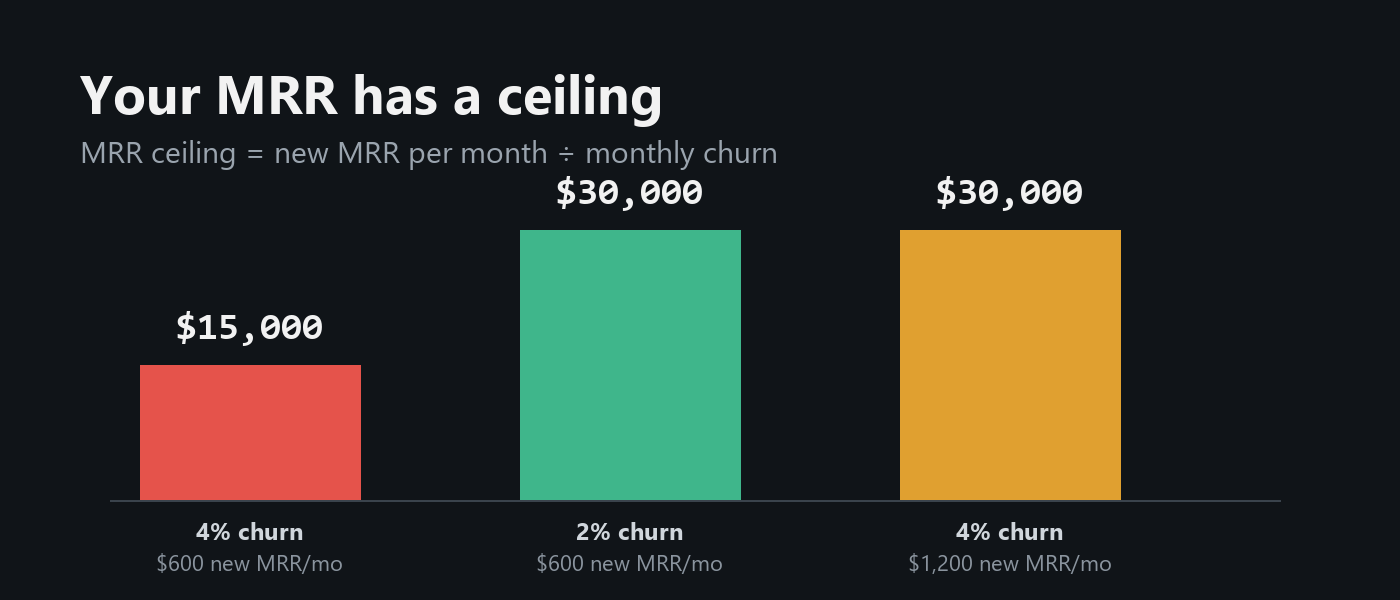
Sole SaaS owners often find their growth hitting a limit despite marketing efforts. This happens because MRR changes only due to two factors: new customers adding revenue (N) and existing customers cancelling (churn rate, c). MRR grows when N exceeds c × MRR, but eventually, they equalize, creating a ceiling. Your MRR ceiling is N divided by c.
Consider adding $600 new MRR each month with a 4% churn rate. Your ceiling will be $15,000, and you will never exceed this figure. Over time, growth slows as your MRR nears this ceiling. For instance, after 60 months, you'd have $13,705 MRR and have lost roughly 39% of your customers.
This slowdown looks like a market trend, but it's actually your numbers. Each month, the growth amount shrinks, e.g., at $5,000 MRR, you gain $400, and at $10,000, you gain $200. Even with the same marketing, net growth diminishes.
To increase your ceiling, you can either raise N (new MRR) or lower c (churn rate). Raising N could involve more customers or higher pricing. Lowering c might mean improving onboarding, offering annual plans, or fixing issues that cause churn. Both levers have different costs: raising N requires ongoing effort, while lowering c often yields long-term benefits.
For a solo founder, lowering churn is generally the smarter move as it's a one-time fix that continues to benefit you after initial changes. Monitoring your MRR and ceiling together can help determine if adjusting N or c is the best course of action.
Written by urgent.news from HackerNoon's reporting — not their text. Machine-written — may contain errors; check the original before relying on it.