Uranus has a weird magnetic field that's stumped scientists for 40 years — we may finally know why
The lopsided magnetic fields of Uranus and Neptune could be the product of extreme conditions inside the planets, increasing the electrical conductivity that enhances the dynamo effect.
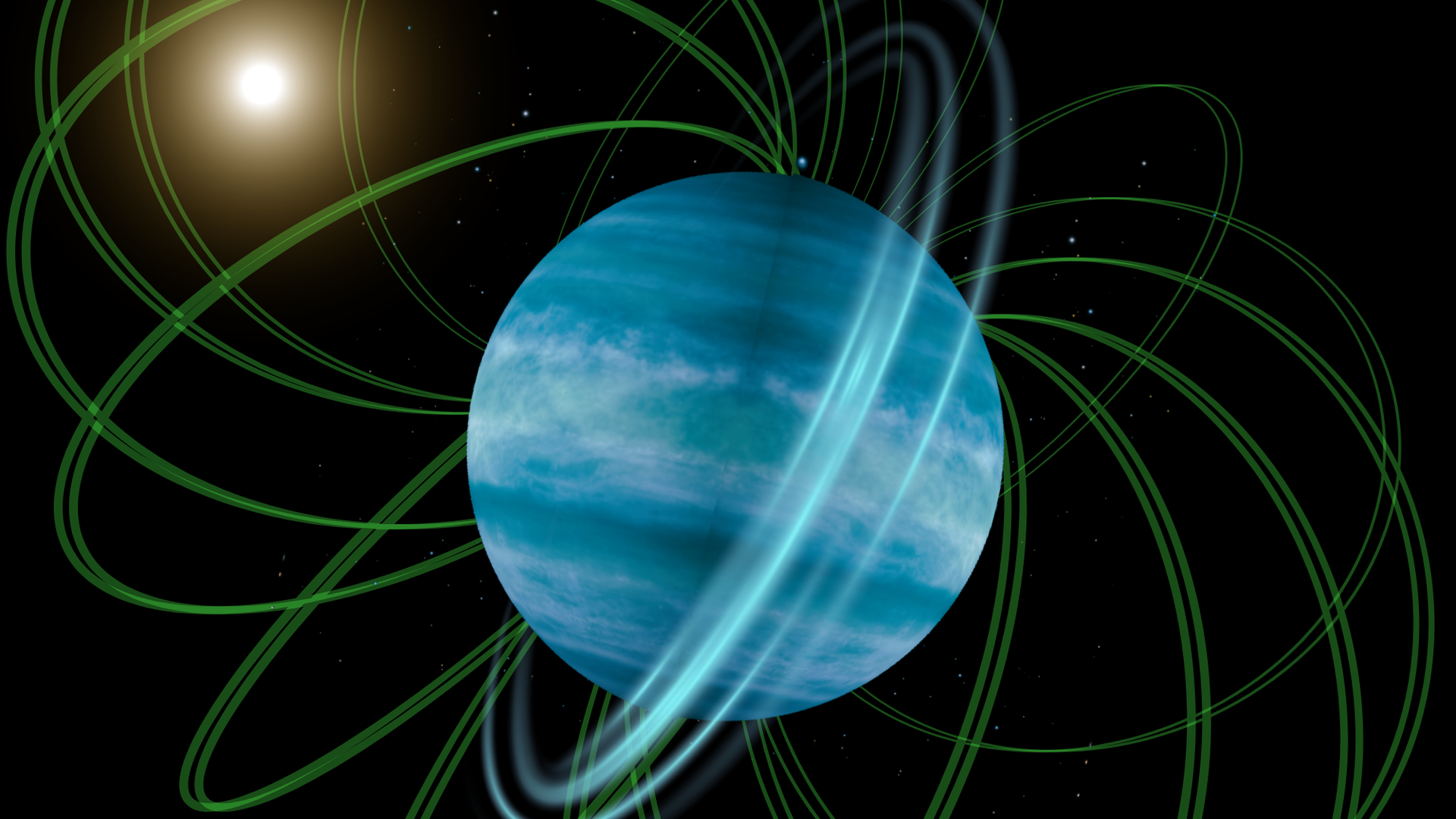
Scientists have puzzled over the strange magnetic fields of Uranus and Neptune for four decades. These so-called ice giants exhibit magnetic fields that are offset and disordered compared to Earth's stable magnetic field. Voyager 2's 1986 and 1989 flybys revealed that Uranus' magnetic field is tilted by 59 degrees and not centered within the planet, while Neptune's field is tilted by 47 degrees and located between the core and visible cloud tops.
Various theories have been proposed to explain these peculiar magnetic fields, but a recent study using computer simulations and Voyager 2 data may have finally cracked the code.
The key to understanding the magnetic fields may lie in the dynamo effect, which generates magnetic fields through the convective motion of an electrically conducting liquid within a rotating body. In Earth's case, this electrically conducting fluid is molten iron in the outer core. However, Uranus and Neptune are vastly different.
They are ice giants with a significant amount of volatile compounds like ammonia, hydrogen, helium, methane, and water surrounding a probable rocky core. Additionally, they are substantially larger than Earth, with masses 14.5 and 17 times greater, respectively. This increased mass leads to extreme conditions deep within these planets, with pressures and temperatures high enough to break apart water molecules into ions, increasing their electrical conductivity.
The computer simulations showed that this growing electrical conductivity, combined with the planets' compositions, could replicate the bizarre magnetic fields of Uranus and Neptune. The simulations also revealed that the magnetic-field structure co-evolves alongside changes in convective fluid motion and temperature inside the planets.
This co-evolution might not be static, as the simulations suggest that the magnetic fields could change significantly within a few decades. This contrasts starkly with Earth's magnetic tilt, which only drifts by a degree or so over 50 years.
Scientists are now eager to gather more data to test their model. Tom Stallard, a co-author of the study and a researcher at Northumbria University, has been leading observations using the James Webb Space Telescope (JWST) to study the faint infrared auroral lights on Uranus and Neptune. Aurorae are generated when charged particles from the solar wind interact with a planet's magnetic field, providing insights into the field's configuration.
By combining JWST's observations with Voyager 2's magnetic-field measurements and the computer simulations, scientists hope to estimate the current configuration of Uranus and Neptune's magnetic fields and compare them to the 1980s data. This could serve as an experimental test for the new model and potentially reveal more about the mysterious interiors of these ice giant planets.
Written by urgent.news from Space.com's reporting — not their text. Machine-written — may contain errors; check the original before relying on it.