SX2026: Balancing Thailand’s AI boom and green energy goals
As global tech giants pour billions of dollars into Thailand’s burgeoning digital infrastructure, the kingdom faces a delicate balancing act between capitalizing on the artificial intelligence (AI) gold rush and mitigating its severe environmental toll. Speaking on the Talk Stage at Sustainability Expo 2026 (SX2026), Dr. Etienne Mueller, Assistant Professor at CMKL University, delivered a […] The…
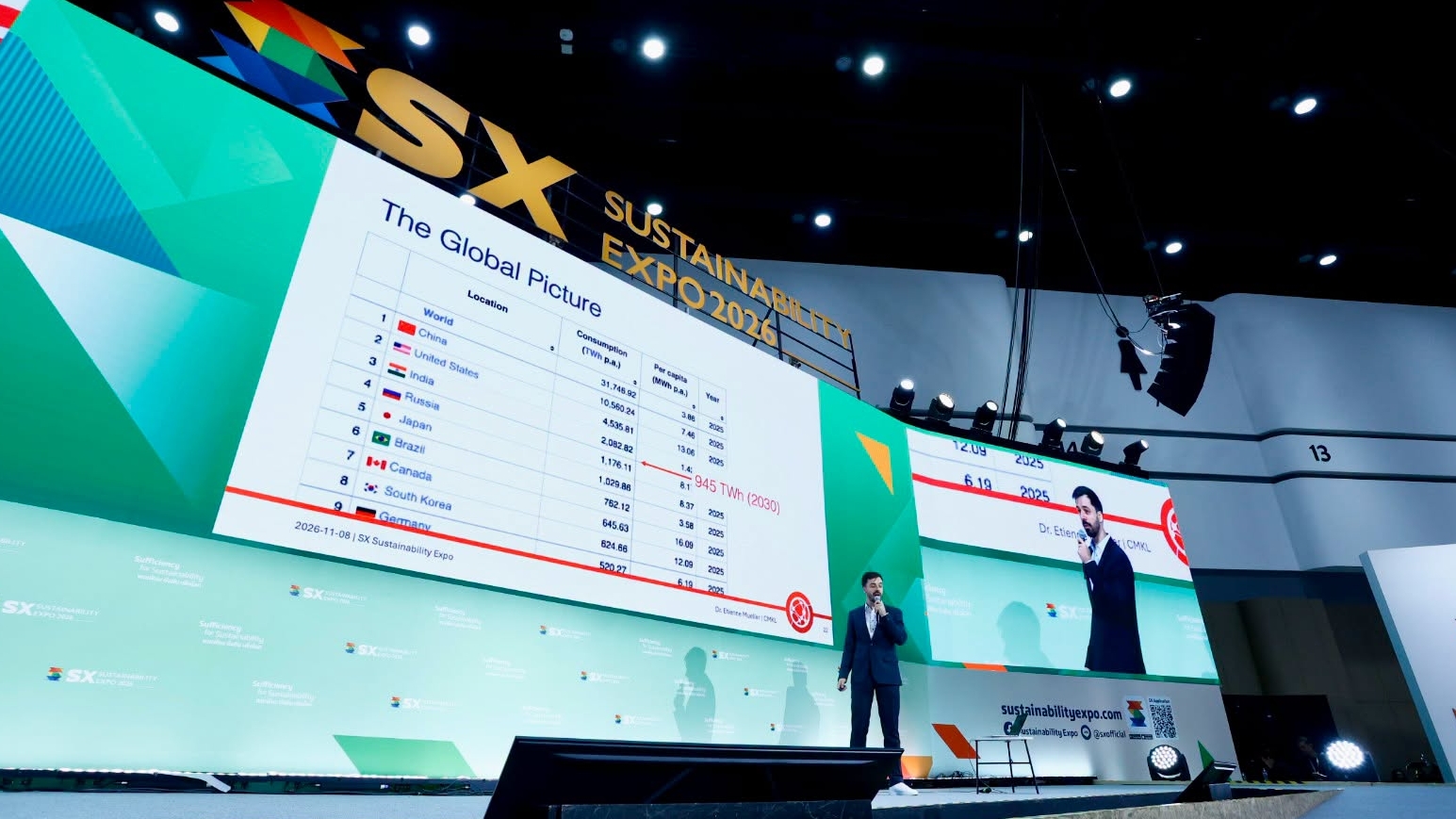
Thailand is rapidly becoming a major player in the global artificial intelligence (AI) and data center industry. However, this growth comes with significant environmental concerns. Dr. Etienne Mueller, Assistant Professor at CMKL University, presented the challenges at Sustainability Expo 2026 (SX2026). He highlighted that while AI efficiency has improved, user behavior has shifted to more complex computations, leading to a massive increase in energy demand.
The energy consumption of data centers is expected to more than double by 2026 and could reach nearly 1,000 terawatt-hours by 2030, surpassing Germany's annual electricity consumption. Training advanced AI models can produce massive carbon emissions, equivalent to driving a car to the sun and back multiple times. Thailand's strategic location, competitive costs, and neutral foreign policy have attracted substantial investment, with 88 AI and data center projects approved in the first half of 2026 alone, totaling US$27 billion.
However, the environmental impact is substantial, with AI infrastructure potentially accounting for 2.5% of Thailand's total national power grid consumption by 2030. Dr. Mueller warned of a "green squeeze" where data centers consume most of the available renewable energy, leaving the local population reliant on non-renewable sources.
To address these issues, he proposed a three-pillar strategy: focusing on software efficiency and localized AI models for developers, adopting advanced cooling solutions and renewable energy agreements for operators, and accelerating renewable energy infrastructure and expansion for policymakers. Despite these challenges, Thailand's public enthusiasm for AI remains high, providing a strategic advantage.
Dr. Mueller concluded that, with proper management, Thailand could become Asia's premier hub for sustainable AI.
Written by urgent.news from Khaosod English's reporting — not their text. Machine-written — may contain errors; check the original before relying on it.