Royal Navy stands up first autonomous boat squadron
Force deploys an operational squadron to gain experience in uncrewed systems as part of its Hybrid Navy vision
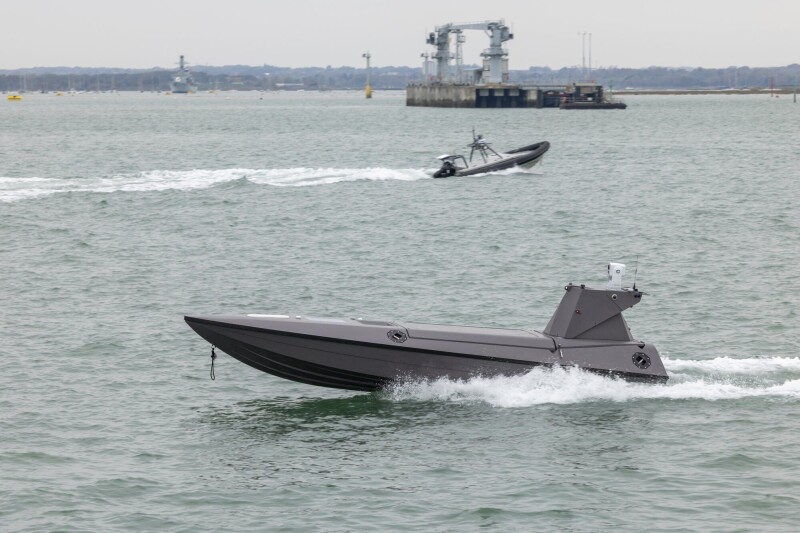
Britain's Royal Navy has officially launched its first autonomous boat squadron, marking a significant step towards its "Hybrid Navy" strategy. The 1st Autonomous Squadron, which came into service on November 5, comprises approximately 180 personnel, equivalent to a Type 23 frigate. The squadron is divided into two watches to ensure round-the-clock operations.
This development supersedes Project Beehive, the navy's experimental program that procured 20 uncrewed boats from UK-based Kraken Technology Group. The Royal Navy is utilizing both the Kraken K3 Scout and the SYOS Aerospace Rattler for this squadron. The K3 Scout, an 8.4-meter vessel, can reach speeds of 55 knots and has a range of up to 650 nautical miles, capable of carrying a payload of up to 600 kg.
It can perform a variety of missions, including anti-ship and anti-submarine warfare, drone detection, and casualty evacuation. The Rattler, measuring 7.2 meters, is equipped with a 500 kg modular bay and can cover up to 950 nautical miles. It was recently used in a demonstration where five uncrewed boats were remotely piloted to escort a patrol ship and a mine countermeasures mothership.
The new squadron's mission will involve acting as a pathfinder for drone operations, testing additional unmanned surface vessels (USVs), and conducting various operations alongside other entities, either individually or as part of a task group. The "Hybrid Navy" concept, outlined by First Sea Lord General Sir Gwyn Jenkins, emphasizes the importance of uncrewed vessels in addressing the gaps left by the Royal Navy's reduced surface fleet.
Fleet Commander Vice-Admiral Steve Moorhouse hailed the launch as an historic occasion but cautioned that the seas are becoming more contested, dangerous, and challenging to operate in. The Royal Navy has also recently launched strike drones from one of its aircraft carriers for the first time, employing BAE Systems' one-way drones and a Tekever AR5 fixed-wing uncrewed aircraft.
Additionally, the Ministry of Defence (MoD) recently launched a British-built satellite called Titania into orbit, which will provide the Armed Forces with new space-based intelligence, surveillance, and reconnaissance capabilities.
Written by urgent.news from The Register Science's reporting — not their text. Machine-written — may contain errors; check the original before relying on it.