Macron’s Angkor visit highlights France’s custodial role
Former colonial power France plays a pivotal role in conservation projects in Cambodia.
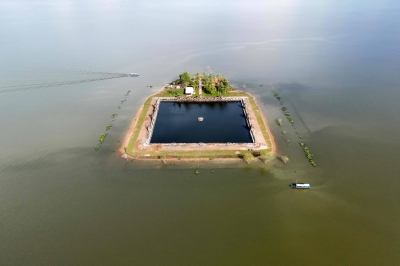
Siem Reap: The recently restored West Mebon temple emerges from a reservoir within Cambodia's vast Angkor archaeological site, marking a century-long conservation legacy initiated by France, its former colonial ruler. French President Emmanuel Macron and Cambodian King Norodom Sihamoni are set to officially open the nearly 1,000-year-old temple during a summit of French-speaking nations in Phnom Penh on November 15-16.
Over the past 14 years, conservationists have painstakingly restored the 16 towers and adjacent walls, completing the installation of a stone marker at the entrance last week. The temple is part of the UNESCO World Heritage site at Angkor, once the epicenter of the Khmer Empire, alongside the revered Angkor Wat. The discovery of Reclining Vishnu, the largest bronze statue ever unearthed in Cambodia, also took place here.
The site is steeped in myth; in 1936, a villager reportedly dreamed of the Buddha requesting to be liberated from the earth, prompting the excavation that unearthed the statue. The temple's restoration resembles the assembly of a colossal 3D puzzle without a reference model, as noted by French project coordinator Sarah Coudry. The French School of Asian Studies (EFEO), founded in 1908 under French supervision, has been instrumental in clearing, cataloguing, and safeguarding the archaeological remnants overrun by the jungle.
While the legacy of colonial rule remains contentious, archaeologist Roland Fletcher of the University of Sydney acknowledges France's valuable contribution. EFEO's work has exposed one of humanity's greatest cultural achievements to the world, a sentiment echoed by EFEO's director Eric Bourdonneau, who emphasizes the institution's role as a research hub encompassing various disciplines to enhance understanding of Cambodia's history and society.
Conservation efforts at Angkor have become an international endeavor since Cambodia's independence in 1953, with contributions from Japan, South Korea, India, and China, but France retains a unique status due to its extensive involvement in excavations, inventories, and documentation spanning over a century. The French also provide invaluable documentation, which Cambodians rely on to study archaeology and monumental architecture, with some Cambodians, like 32-year-old architect Meng Sovanlylin, now benefiting from the knowledge transfer.
Additionally, the French presence offers practical advantages, such as decent salaries and pension plans, as mentioned by 65-year-old worker Phem Phan.
Written by urgent.news from New Straits Times's reporting — not their text. Machine-written — may contain errors; check the original before relying on it.
This story
This is one outlet's version. Read the fullest account.
- Macron's Angkor visit highlights France's custodial role gulfnews.com
- Covert Russian network uses France’s riots to paint Macron’s government as weak. Same operation targets support for Ukraine — Reuters euromaidanpress.com
- Macron's Angkor visit highlights France's century-long conservation role nst.com.my
- Russian government approves sale of 128 over-the-counter medications at post offices meduza.io
- Ukraine war: 400,000 Russian deaths, the toll Vladimir Putin tried to hide lemonde.fr
- EU launches emergency Ukraine aid mechanism as Russian attacks intensify english.nv.ua