Israel: Wie das Eisenkot-Lager Netanjahu ausbremsen will
Die bisherige Opposition in Israel hat in der konstituierenden Sitzung erste Schritte eingeleitet, um Premier Netanjahu zu entmachten. Doch eine tragfähige Mehrheit zeichnet sich bislang nicht ab.
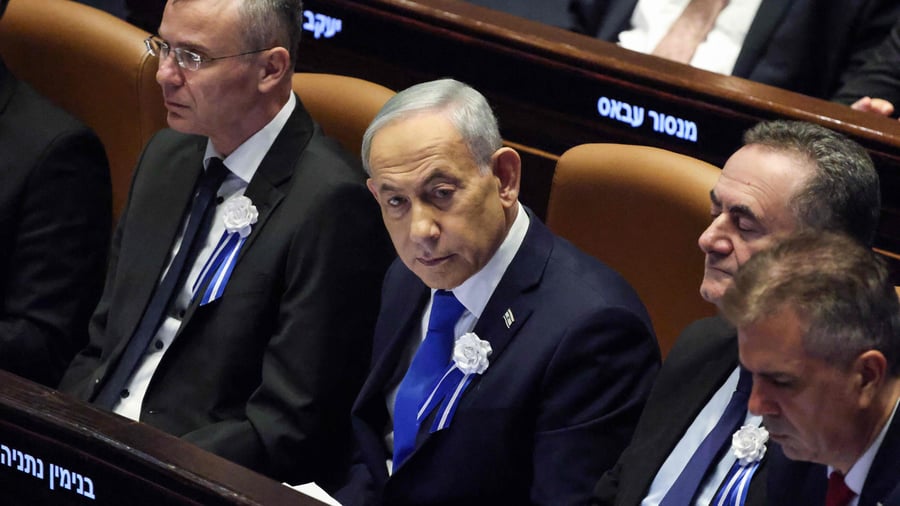
Two weeks after Israel's election, the new 26th Knesset convened for its first session. During the swearing-in on Tuesday in Jerusalem, much attention focused on the office of the Knesset President. Current incumbent Amir Ohana, a close associate of incumbent Prime Minister Benjamin Netanyahu, was set to be replaced at his request.
The question was who would succeed him and what they would be able to achieve in Parliament. The Likud party, led by Netanyahu, emerged as the strongest political force in the recent October 27th elections, but lost its parliamentary majority. President Izchak Herzog appointed Gadi Eisenkot, a former general and head of the Yachad party, to form the government.
He was given four weeks to negotiate, with the possibility of an additional two weeks. Should the talks fail, it is likely that the government formation will be transferred to Netanyahu. Eisenkot stated he wanted to form the government "as quickly as possible," but negotiations would be difficult. He would need either the 19 seats from the Arab parties or the 13 seats from the ultra-Orthodox parties to achieve a majority.
Both options would require him to abandon key election promises. The office of Knesset President therefore became the first lever to control the situation. Eisenkot's faction had 61 signatures secured for Ohana's replacement and planned to vote on Tuesday. Matan Kahana, previously Minister for Religious Affairs, was agreed upon as the successor.
Initially, Jair Lapid, a former Prime Minister and opposition leader, was named, but Eisenkot insisted on choosing someone from his own party. The Arab coalition "United List" also wanted Kahana to be elected. They stated they wanted to be part of the change. "We want to be part of the change," said their vice-chairman Ahmad Tibi to Israeli news channel Kan.
The office of Knesset President is powerful as it co-decides the agenda and committee assignments. Even before a government is formed, the committee that controls the agenda can appoint two preliminary expert committees. Their chairmanship has already been announced by opposition: Avigdor Liberman, head of the Israel Beitenu party, will lead the Foreign Affairs and Defense committees, while Liran Avisar Ben Horin of B’Yachad will be the first woman to lead the Finance committee.
Liberman would gain access to sensitive information from the military and intelligence services. The Finance committee decides on budget issues. So the Eisenkot faction could constrain Netanyahu's power before a new government even takes office. Opposition parties had already introduced legislation on Tuesday. They proposed a state investigation commission for the Hamas attack on October 7, 2023, calling for a term limit for government leaders, as Liberman demanded.
They also included proposals to revoke legal reforms: the Public Prosecutor's Office, judges' selection, media reform, and subordinating investigative officers to the Minister of Justice. The October 7, 2023 terror attack defined the new Knesset. The atmosphere in the constituent session was charged, with Yousef Jabareen, president of the United List, raising the issue of officially labeling Hamas as a terrorist organization.
Police Minister Itamar Ben-Gvir interrupted him, demanding a commitment to Hamas. Abbas, head of the more moderate Arab party Ra'am, was reportedly willing to label Hamas as a terrorist organization if it meant gaining a seat in the coalition, though he did not confirm. Knesset President Ohana aimed in his opening remarks to clarify that Hamas is a terrorist organization, regardless of whether political negotiations acknowledged it.
The stakes of the 7th October attack were also evident in the swearing-in ceremony, as Likud Member of Knesset Elisha Medan stood up to swear his oath, accompanied by applause from the entire Knesset. Medan and 13 other Likud members had personally experienced the October 7 attack and the Gaza War, losing limbs or loved ones. Even Eisenkot lost his son and two nephews in the attack.
The election of the Knesset President was the first test for Eisenkot's faction to work with Arab members without including them in the government.
Written by urgent.news from Handelsblatt's reporting — not their text. Machine-written — may contain errors; check the original before relying on it.