Famous Fossil Could be Rosetta Stone for Hidden Hominin Diversity
What would the Taung child grow up to be? The post Famous Fossil Could be Rosetta Stone for Hidden Hominin Diversity appeared first on Nautilus .
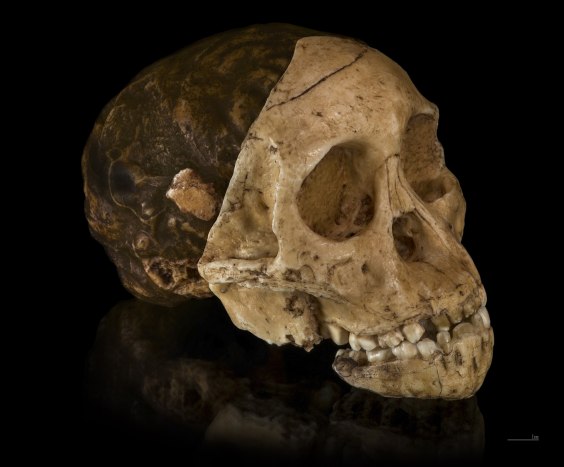
The 1924 discovery of the Taung child’s skull marked a pivotal moment in comprehending human origins. It was the first Australopithecus specimen ever unearthed, serving as the holotype against which future specimens were measured. Recently, a team of international paleobiologists re-examined the skull and unearthed new insights in a study published in npj Palaeoecosystems.
By evaluating the tooth mineralization rate against that of chimpanzees, gorillas, humans, and other fossils, they concluded the skull belonged to a child, not a juvenile as initially thought. Dentine-enamel junction analysis revealed similarities to Paranthropus robustus, an ape-like hominin that likely emerged after Australopithecus.
Examining the braincase, the researchers discovered further inconsistencies when digitally reconstructed skulls from the same region, purportedly belonging to Australopithecus, were compared to the Taung child’s braincase. Their findings suggest the Taung child’s skull could have evolved into a hominin resembling some Australopithecus forms, but not all.
This implies a greater variability among hominins inhabiting the region during that time, potentially overshadowed by a single classification. Additionally, their paleoclimate analysis revealed a region experiencing constant fluctuations, potentially driving hominin diversity through population expansion, contraction, and interbreeding driven by changing pathogens and predators.
Study author Gabriele Macho of Vrije Universiteit Brussel stated, "For over 100 years, we assumed the Taung Child was just one of many similar fossils from the era. Our findings turn that on its head." Their study suggests the human family tree was more convoluted than previously believed, rather than a linear progression. However, the researchers caution this remains a hypothesis, emphasizing that our understanding of human evolution continues to evolve as new evidence emerges.
Written by urgent.news from Nautilus's reporting — not their text. Machine-written — may contain errors; check the original before relying on it.