Netanyahu rival Eisenkot seeks 'wide' government but path to power uncertain
Eisenkot's potential pathways to power include trying to form a minority government with Arab party support for key issues; forming a coalition with ultra-Orthodox parties that he and his allies have shunned in the past; or forging a unity government with Netanyahu.
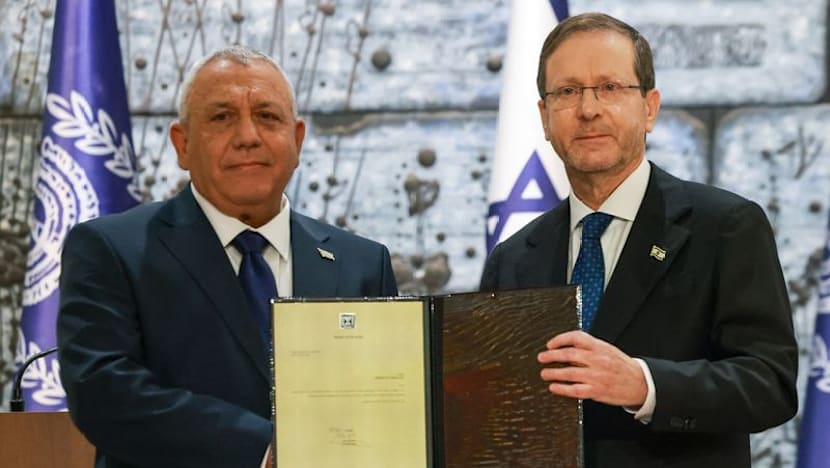
Former Israeli military chief Gadi Eisenkot announced on Sunday that he aims to form a wide government as soon as possible, following a hung election that failed to remove Prime Minister Benjamin Netanyahu. Israeli President Isaac Herzog assigned Eisenkot the task of forming a new government after the Oct 27 poll, which left both Eisenkot and Netanyahu lacking the majority needed for governance.
Eisenkot believes this will be an "extraordinarily complex" process, stating that Israel is at a vulnerable moment due to threats like Iranian attacks, Gaza peace negotiations, and Lebanon's relations. He outlined three potential paths to power: forming a minority government with Arab party support, creating a coalition with ultra-Orthodox parties (previously dismissed), or forming a unity government with Netanyahu.
All three options face significant hurdles. Eisenkot insists on specific principles for any coalition, including recognizing Israel as a Jewish and democratic state, obligating national service, and condemning Hamas as a terrorist organization. He has 28 days to attempt forming a government, with a possible extension of 14 days.
If unsuccessful, Netanyahu will likely take another chance, and new elections could be called. Herzog consulted with all parties and stated that Eisenkot had the majority's support in forming the next government. Netanyahu's Likud secured the most votes with 27 seats, but his broader coalition had only 53 seats, falling short of the 61-seat majority needed.
Eisenkot's Yashar party was the second-largest with 21 seats, while his coalition of four center-left to right-wing parties won 48 seats. Israel's Arab parties won 19 seats. Netanyahu called for a unity government of all Zionist parties but ruled out any coalition with Arab parties, who constitute 21% of the Israeli population. Opposition leader Avigdor Lieberman, from the Israel Our Home party, has yet to decide on a unity government with Netanyahu or a minority government with Arab backing.
Given the current circumstances, Lieberman believes difficult decisions are necessary to end Netanyahu's rule.
Written by urgent.news from Channel News Asia's reporting — not their text. Machine-written — may contain errors; check the original before relying on it.
Also reported by 4 other outlets
- Netanyahu rival Eisenkot seeks 'wide' government but path to power uncertain al-monitor.com
- Israel’s president gives Eisenkot first chance to form next government japantoday.com
- 28 days to replace Netanyahu: Can Eisenkot form Israel's next government? haaretz.com
- Eisenkot gets nod to form government, vows ‘unconventional acts’ in time of ’emergency’ timesofisrael.com