Israel: Diese Optionen hat Eisenkot nun für die Regierungsbildung
Israels Staatspräsident Herzog hat Oppositionspolitiker Gadi Eisenkot mit der Regierungsbildung beauftragt. Dieser hat nun drei Möglichkeiten, die jeweils unterschiedliche Risiken enthalten.
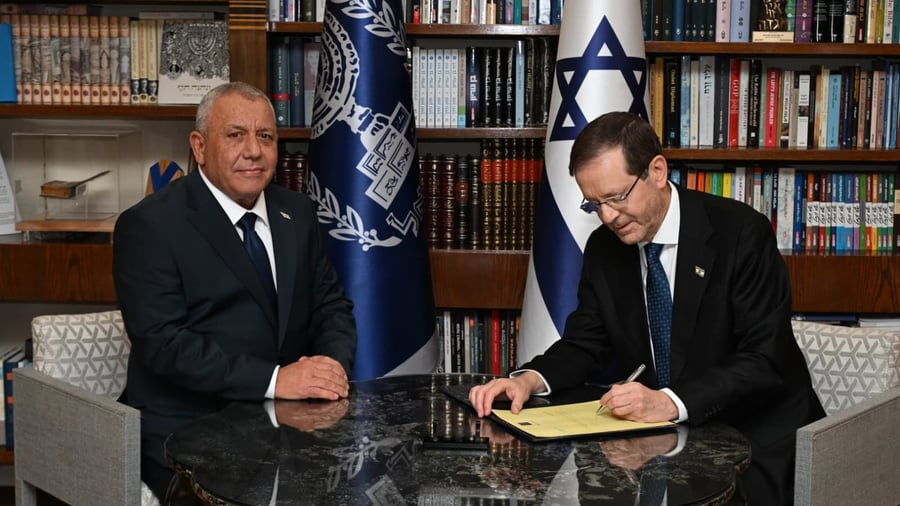
After Israel's parliamentary election on October 27th did not produce a clear winner, President Isaac Herzog appointed Gadi Eisenkot to form the government on Sunday. During the ceremony in Jerusalem, Herzog spoke of "immense challenges," including threats from Iran, implementing the Gaza Strip peace plan, conscription issues, resisting sanctions and diplomatic threats, and dealing with a "new political landscape" in the United States.
He stated that Israel needs a stable government capable of meeting these demands in the long term. Eisenkot now has 28 days to form a coalition, which Herzog can extend by up to 14 days. The President had previously received all the factions for two days. Of the 120 designated MPs, 67 recommended Eisenkot as the chief, while only 46 supported Netanjahu.
The ultra-Orthodox United Torah Judaism party (UTJ) with seven seats gave no recommendation. If Eisenkot fails to form a coalition within this time, Herzog may be appointed as the next incumbent, Benjamin Netanyahu. Despite support, it will likely be difficult for Eisenkot to find a stable majority. "We are close to a point from which there is no going back for the state of Israel," Eisenkot said after receiving the mandate.
"It will require creative and unconventional political steps." Opposition and government camps without a majority According to the election results, Netanyahu's current government coalition with 53 seats is in the lead. It consists of the Likud, the strongest party with 27 mandates, the ultra-Orthodox parties Shas (six seats) and UTJ (seven seats), and the right-wing settlement parties Religious Zionism of Bezalel Smotrich and Otzma Yehudit of Itamar Ben-Gvir, together with 13 seats.
Eisenkot's opposition coalition, on the other hand, only reached 48 mandates. It consists of four parties that primarily aim to replace Netanyahu: Yashar ("straightforward") promotes moderate, security-oriented policy, seeks to introduce universal conscription, and establish an investigation commission regarding the October 7th, 2023 Hamas attack.
They were the second-largest force with 21 seats. The alliance B'Yachad (with Naftali Bennett and Yair Lapid) has 12 seats, and Avigdor Liberman's secular party Yisrael Beitenu has seven. The left-wing faction HaDemokratim, led by Yair Golan, has eight seats. Despite this, Eisenkot was first appointed to form the government because his support from Arab parties would put him ahead.
Ra'am and HaReshima HaMeshutefet (Common List) together have 19 seats. Both want to prevent another term for Netanyahu. This results in the 67 recommendations. For a government majority, 61 seats are needed. With so many recommendations, forming a government will be difficult. Many recommendations, but no majority Due to the four conditions Eisenkot affirmed for joining his government on Sunday, forming the government will be challenging: recognizing Israel as a Jewish, democratic, and liberal state with equality, commitment to the values of the Declaration of Independence, mandatory service for all citizens, classifying Hamas as a terrorist organization and dismantling its military capabilities and structures in the Gaza Strip.
The ultra-Orthodox parties Shas and UTJ refuse to serve in the government for religious reasons. The Arab parties refused to call Hamas a terrorist organization during the consultations on Thursday. Even Mansour Abbas, the head of Ra'am, who is considered moderate and was the first Arab party representative in a government in 2021, called for disarming Hamas but refused to classify it as a terrorist organization.
He pointed to security concerns for himself and his family. Because of the conditions, only 48 MPs will actually serve with Eisenkot. "Somewhere, the opposition must now make compromises," says Michael Rimmel, head of the Konrad-Adenauer-Stiftung's office in Israel. "Every step will cost them their political credibility." Eisenkot now has three options: Option 1: Coalition with Arab parties Eisenkot could soften his conditions enough for the Arab parties to join him.
Rimmel believes this is nearly impossible, as the security interests of the former army chief and the Arab MPs are too far apart. It is more likely that the Arab parties would merely tolerate the situation. Only HaDemokratim expressed willingness for such a coalition in opposition circles. Option 2: Government with ultra-Orthodox Eisenkot could form a government supported or tolerated by the ultra-Orthodox.
This alliance was considered impossible before the election. The UTJ abstained in the consultations, suggesting the party is distancing itself from Netanyahu. Since 2009, the UTJ has been part of his government coalition. The Channel 12 news channel quoted a source from the Council of Torah Sages: The second ultra-Orthodox party, Shas, would not vote against a government with Eisenkot if its spiritual leader agreed.
Netanyahu, however, is reportedly exerting significant pressure on the ultra-Orthodox parties to prevent this alliance. "Read more: Keep up with all current developments in the Middle East in the news blog."
Written by urgent.news from Handelsblatt's reporting — not their text. Machine-written — may contain errors; check the original before relying on it.
This story
This is one outlet's version. Read the fullest account.
- Netanjahu vor dem Aus?: Ex-Militär Eisenkot soll Regierung in Israel bilden handelsblatt.com
- Eisenkot eyes Israel govt as party drops Netanyahu economictimes.indiatimes.com