Diwali 2026: Can Green Crackers Balance Clean Air And Sivakasi’s Livelihoods?
Every year, as Diwali approaches, the debate over firecrackers resurfaces. Restrictions are announced, courts intervene, and conscientious citizens urge people to celebrate without adding to pollution. The arguments can quickly turn acrimonious, with those calling for restraint often accused of opposing religious traditions. Yet, even as the debate rages, fireworks continue to be manufactured and…
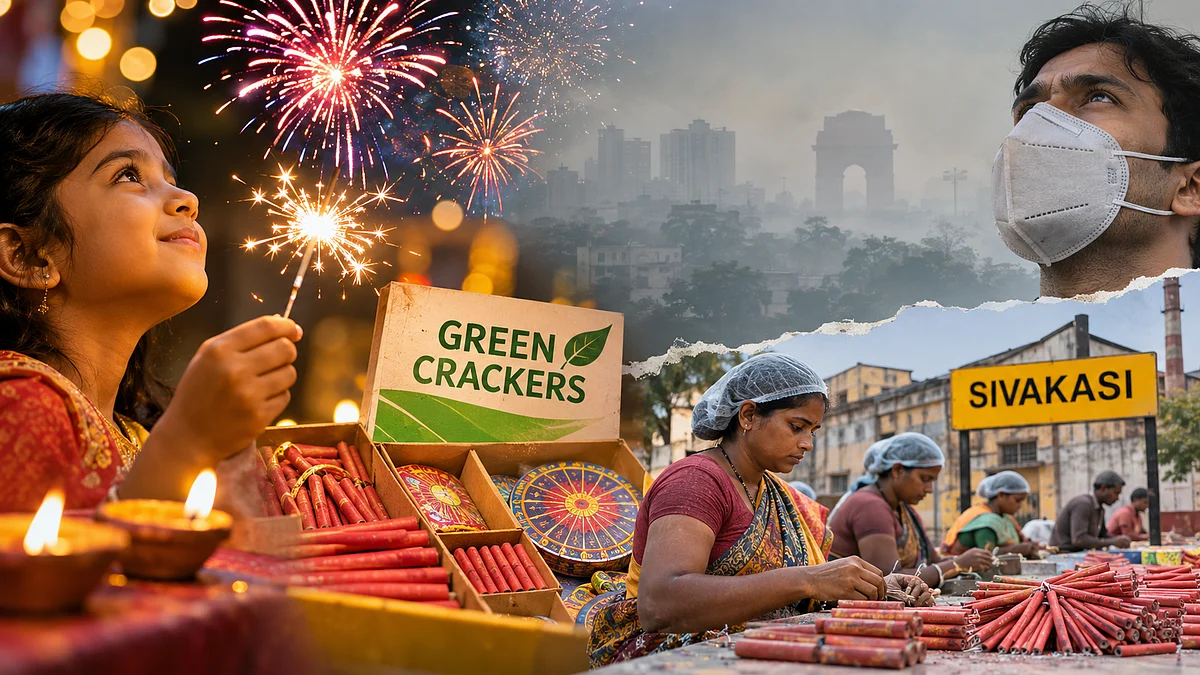
Diwali 2026 may see the implementation of a new type of fireworks called "green crackers." These are designed to emit fewer pollutants than traditional firecrackers. The Supreme Court recently granted a temporary exemption for green crackers, reigniting the debate over striking a balance between clean air and celebrating the festival.
Green crackers are the brainchild of the Council of Scientific and Industrial Research's National Environmental Engineering Research Institute (CSIR-NEERI). They come in three forms: SWAS, STAR, and SAFAL. According to the NEERI team, these alternatives emit 30% less particulate matter or 20% less particulate matter and 10% fewer gases than regular crackers.
The formulations involve changes in fuel and oxidiser proportions, additives to reduce dust, and lower quantities of specific metals. The packaging includes a CSIR-NEERI logo and a QR code for buyers to verify the certification.
However, critics argue that "green" does not mean "pollution-free." Green crackers are simply a step towards less-polluting alternatives, but they still involve burning. According to Dr. Abhijit Ahuja, a pulmonologist at Saifee Hospital, Mumbai, exposure to firecracker emissions can lead to irritation of the respiratory system, with effects varying based on pollutant concentration and exposure duration. Fine particles can even enter the bloodstream, causing systemic inflammation.
While green crackers are safer than conventional ones, they do not guarantee cleaner air. The pollution from firecrackers depends on the number of crackers used and the conditions under which they're burst. Even lower-emission products can contribute to air pollution when used in large quantities. Nitin Kaushal, Managing Director of SFK Group of Companies, agrees that reducing the number of crackers and using cleaner alternatives can benefit air quality.
Written by urgent.news from Free Press Journal's reporting — not their text. Machine-written — may contain errors; check the original before relying on it.