Better hearing is not just about the ears: How blindness changes sound processing
Research indicates that individuals who lost their sight at an early age may have better hearing capabilities. They show enhanced pitch discrimination compared to sighted individuals, suggesting brain adaptations due to blindness. Additionally, sighted musicians exhibit similar auditory improvements through musical training. The study highlights the significance of internal noise in the brain's…
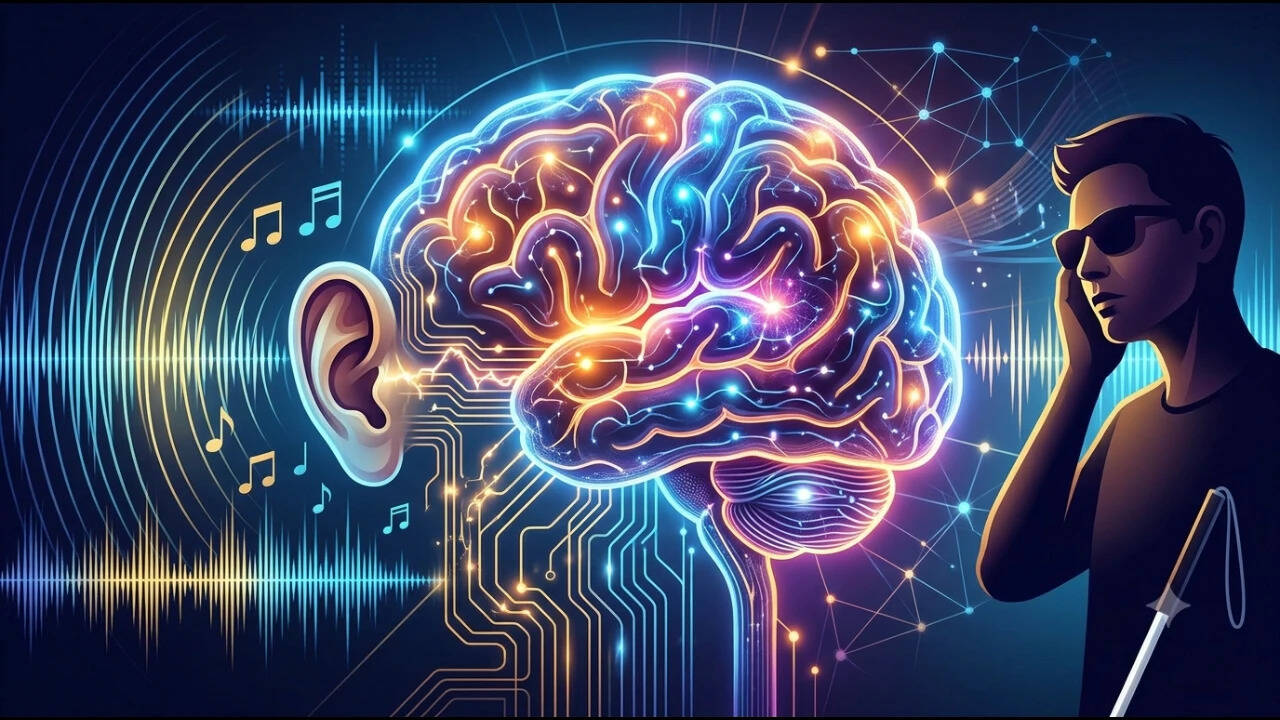
Individuals who have been blind for most of their lives may exhibit enhanced hearing abilities due to more consistent and reliable processing of sound by their brains, according to a recent study published in the Journal of Neuroscience. While some might assume that improved hearing stems from increased sensitivity to various sound frequencies, the research reveals that this is not the primary factor.
Instead, early-life blindness appears to lead to a more reliable brain response to auditory information, rather than merely heightened ear sensitivity.
The study involved a comparison between nine individuals who became blind before the age of two and 18 sighted participants, with varying degrees of musical training. Researchers measured hearing abilities through two tasks. The first task required participants to detect a tone amidst background noise, allowing for the assessment of how the cochlea, responsible for processing sound frequencies, responded to different pitches.
The second task involved identifying which of two tones had a higher pitch, relying on the brain's ability to interpret auditory information.
The findings indicated that individuals with early-life blindness outperformed sighted participants only in the pitch discrimination task. This suggests that their improved hearing abilities likely result from changes in brain processing of sound, rather than differences in the ears' ability to detect different frequencies. To understand the underlying mechanisms, the researchers employed a mathematical model showing that individuals with early-life blindness had lower levels of "internal noise" within their auditory systems.
Internal noise refers to the consistency of the auditory system's response to the same sound over time. Lower internal noise translates to more reliable brain processing, making it easier to differentiate between similar sounds.
Interestingly, the study also found that sighted musicians demonstrated lower internal noise and exhibited more consistent responses to sounds compared to those who had neither early-life blindness nor extensive musical training. This suggests that musical training can similarly enhance hearing abilities, indicating that diverse sensory experiences can impact auditory processing.
The findings underscore the significance of brain plasticity—the brain's capacity to adapt its responses based on experience. The researchers explained that the brain adjusts its responses to critical information acquired through life experiences. This adaptability is evident in various scenarios, such as children learning to read or adults developing the ability to recognize different bird species.
The study identifies internal noise as a crucial factor in this plasticity process. It is hypothesized that sensory experiences, including blindness and musical training, assist the brain in developing and refining templates for interpreting sound, ultimately improving auditory processing.
Moving forward, researchers aim to explore ways to harness this insight to enhance auditory abilities through targeted training. For instance, training in recognizing the location of sounds could assist individuals beginning to lose their vision in relying more on auditory cues for navigation. However, several questions remain unanswered, such as the required duration and nature of training to elicit meaningful changes in the brain and which specific aspects of auditory experience are most impactful.
Additionally, researchers are interested in understanding whether the effects of brain plasticity vary depending on the timing of vision loss or the onset of musical training. It is possible that the brain exhibits greater plasticity during early development, implying that sensory experiences might influence brain function differently in adulthood.
Future investigations will explore whether the improved pitch discrimination observed in individuals with early-life blindness and sighted musicians extends to more complex, real-world listening situations, providing a deeper understanding of the practical implications of these findings.
Written by urgent.news from Times of India's reporting — not their text. Machine-written — may contain errors; check the original before relying on it.