A Pumice Raft the Size of Sicily Helped Reveal One of The Largest Underwater Volcanic Eruptions of Modern Times
Learn more about pumice rafts, what causes them, and how they can impact ocean life.
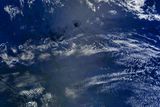
In July 2012, an Australian pilot named Maggie de Grauw observed a massive gray patch on the South Pacific Ocean's surface while returning to Auckland from Samoa. She captured photos of the unusual formation, suspecting it to be a pumice raft. De Grauw sent the images to volcanologist Scott Bryan at the Queensland University of Technology, who confirmed their suspicions.
The pumice raft was located near the Kermadec Islands, situated between New Zealand and Tonga. The scientists then set out to determine the origin of the eruption.
Pumice rafts are formed as a result of underwater volcanic eruptions, where lightweight pumice rock filled with gas bubbles floats on the ocean's surface. The scientists initially searched for the volcano responsible for the pumice raft, but the raft continued to drift. After two weeks, New Zealand soldiers spotted the raft and estimated its size to be roughly the size of Sicily, covering about 287 miles (463 km) long and 34 miles (56 km) wide.
Subsequent satellite data pinpointed the source of the eruption to Havre seamount, an underwater volcano located within the Kermadec island chain. Havre sits on a fault between the Pacific and Indo-Australian tectonic plates, with the Kermadec trench being one of the deepest and most geologically active trenches on Earth. French volcanologist Alain Bernard observed a thermal hotspot emanating from Havre on July 18, 2012, which led to the discovery of the pumice raft by de Grauw a few days later.
The eruption at Havre released lava from 14 separate volcanic vents, reaching depths of up to 4,000 feet (1,220 meters). The largest pumice chunks ejected by the volcano measured approximately 29 feet (9 meters) in diameter. The eruption lasted for about a month, during which the pumice raft grew from a 10-day-olddrift to cover an area of 104,247 square miles (270,000 square kilometers) by August 19, 2012—an area equivalent to New Zealand itself.
The raft eventually broke up, with pieces washing ashore in New Zealand, Australia, and various Pacific islands, while others sank to the ocean floor. Pumice rafts can have both negative and positive impacts on marine life and ocean ecosystems, as they can harm fish due to reduced sunlight and oxygen levels, yet their nutrient-rich composition fosters the growth of plankton as they drift into the deep ocean.
Written by urgent.news from Discover Magazine's reporting — not their text. Machine-written — may contain errors; check the original before relying on it.