The Jewish Sisters in Renoir’s “Pink and Blue”
Author Catherine Ostler follows the lives of the two cherubic girls in “Pink and Blue” (1881), whose rarefied lives in an elite, artistic French family would be toppled by the horrors of the Holocaust.
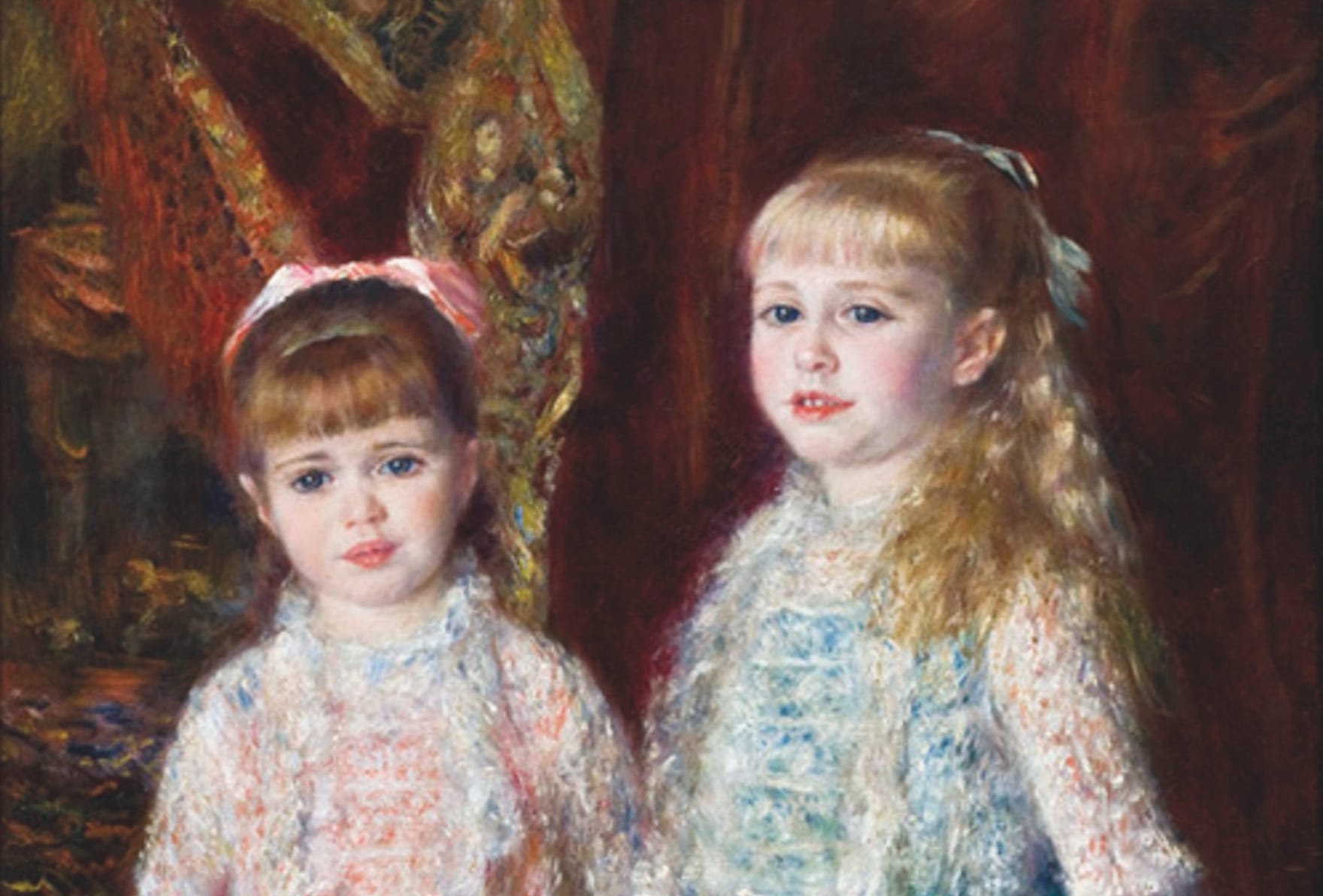
In 1881, Pierre-Auguste Renoir painted a double portrait titled "Pink and Blue, the Misses Cahen d’Anvers" (1881) of four-year-old Alice and six-year-old Elisabeth, daughters of Louis and Louise Cahen d’Anvers, a Jewish banker and salonnière. The two young girls, with rosy cheeks and reddish-golden hair, hold hands in a lavish salon, surrounded by lace and satin, creating a scene of sugared-almond-colored sweetness.
This artwork and a previous portrait of their older sister, "La Petite Irène," (1880) by Renoir, serve as the foundation for Catherine Ostler's book, "The Renoir Girls." Ostler's meticulously researched book paints a vivid picture of the gilded world of fin-de-siècle Paris, the Cahen d’Anvers family's elite status, and the tragic fate that awaited them during the Holocaust.
Louise Cahen d’Anvers, a prominent art patron and hostess, hosted a salon that attracted artists, writers, and members of the conservative Catholic aristocracy. Her lover, art critic Charles Ephrussi, was also suspected of being Alice's biological father. Despite the nation's guarantee of equal rights for its Jewish population following the French Revolution and the Napoleonic Code, antisemitism persisted.
It manifested through resentful grumbles and the venom of anti-Semitic writers like Edmond de Goncourt. The peak of this crisis came during the Dreyfus Affair (1894-1906), which tested the loyalty of the Cahen d’Anvers and their circle. Despite their deep love for France and their commitment to assimilation, the family's fortunes changed dramatically in the 1930s as the Nazis occupied France, leading to the persecution and tragic deaths of four family members, including Elisabeth, who died in Auschwitz in 1944.
The paintings "Pink and Blue" and "La Petite Irène" now reside in the Museu de Arte de São Paulo Assis Chateaubriand and the Kunsthaus Zürich, respectively, bearing witness to the devastating events that befell this once-prominent Jewish family.
Written by urgent.news from Hyperallergic's reporting — not their text. Machine-written — may contain errors; check the original before relying on it.