The constellation Andromeda the Chained Lady
The constellation Andromeda the Chained Lady is most famous for containing M31, the Andromeda Galaxy, the closest large spiral galaxy to the Milky Way. The post The constellation Andromeda the Chained Lady first appeared on EarthSky .
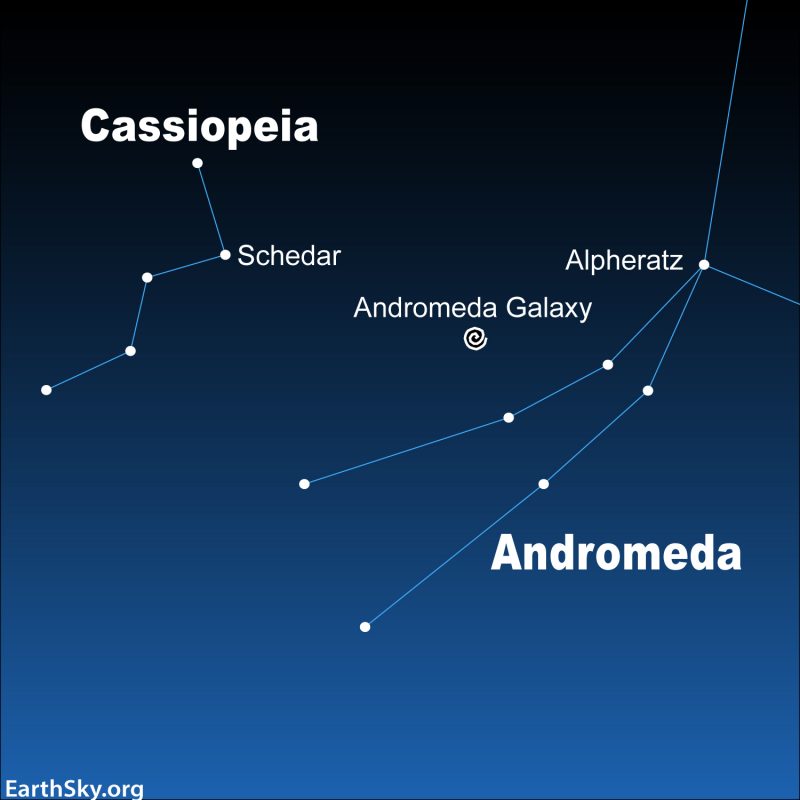
The constellation Andromeda, also known as the Chained Lady, is named after a character from Greek mythology. In the story, Andromeda was the daughter of Queen Cassiopeia and King Cepheus, who were chained up and offered as a sacrifice to appease the sea monster Cetus. However, she was ultimately saved by the hero Perseus and went on to become his queen. In the night sky, Andromeda is accompanied by her parents, Queen Cassiopeia and King Cepheus, and she also contributes a star to the Great Square of Pegasus.
To locate Andromeda, look for the W-shaped constellation Cassiopeia high in the sky in the months of November and December. Andromeda is positioned next to the Great Square of Pegasus, with one of the square's stars belonging to Andromeda itself. Cassiopeia's W shape serves as a guide, with the V-shaped side pointing towards Andromeda. Although Cassiopeia's V does not point directly to Andromeda, viewers should look slightly to the right to find the Andromeda Galaxy (M31), located about 15 degrees away.
Andromeda is the 19th largest constellation by size among the 88 constellations. It contains several bright stars, with Alpheratz being the brightest at magnitude 2.06 and located 97 light-years away. Mirach and Almach, both magnitude 2.06 stars, are located at 197 and 355 light-years away, respectively. The brightest star in the Great Square of Pegasus, Alpheratz, is part of Andromeda.
Written by urgent.news from EarthSky's reporting — not their text. Machine-written — may contain errors; check the original before relying on it.