Khopta Bridge Undergoes ₹5-Crore Restoration Using Advanced Technology, Expected To Reopen By November 10
Navi Mumbai: Carbon laminates, Ultra High Performance Fibre Reinforced Concrete (UHPC-FRC), new central hinge bearings and advanced expansion joints are among the technologies being used to strengthen the old Khopta Bridge, which is undergoing a Rs 5-crore restoration. The 240-metre-long bridge is expected to reopen by November 10. UHPC-FRC is an advanced and highly durable concrete technology.…
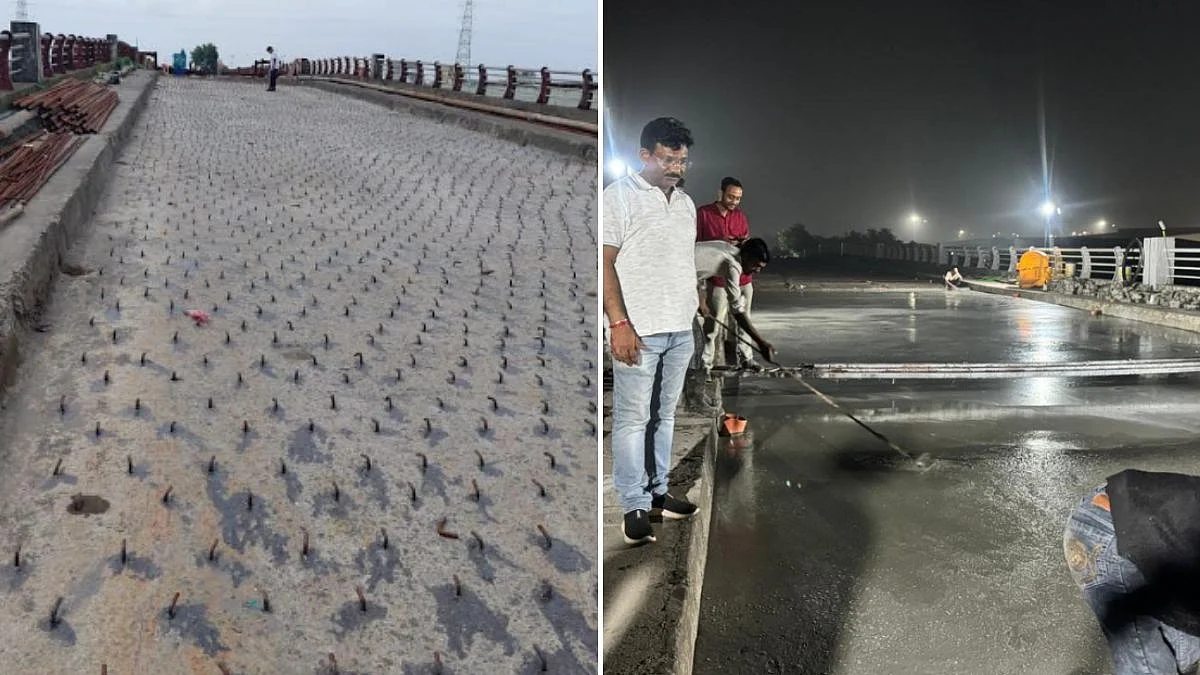
Navi Mumbai observes a ₹5-crore renovation on the 240-meter-long Khopta Bridge, employing cutting-edge techniques like carbon laminates, Ultra High Performance Fibre Reinforced Concrete (UHPC-FRC), and advanced expansion joints. The bridge, which connects Uran's rural areas to the rest of the region, is slated to reopen by November 10. This restoration aims to extend the bridge's lifespan by a minimum of 15 years, according to Public Works Department (PWD) officials.
Engineers are reinforcing the five bridge spans, replacing the central hinge bearings, installing newer flinger-type expansion joints, casting the deck slab, and utilizing carbon laminates to bolster the internal structure. M-80 grade concrete will be employed for the deck slab, while the restoration is being carried out with administrative approval of Rs 5 crore and technical approval of Rs 4.60 crore, as stated by Deputy Engineer Damodar Patil of PWD, Uran.
The bridge, originally constructed in 1990, was initially designed for light vehicles but has evolved into a crucial transport link due to the development of the Jawaharlal Nehru Port Authority (JNPA) and surrounding industries. However, the bridge's limited load-bearing capacity has led to its frequent use by heavy vehicles and container trucks, resulting in structural deterioration.
The closure of the bridge in November 2025 has resulted in increased traffic pressure on the adjacent bridge, causing congestion and inconvenience for residents.
The restoration work has faced technical challenges, including the absence of access provisions between the bridge spans, forcing engineers to create a separate access route for repairs. Despite these challenges, the restored bridge is expected to remain in good condition for at least 15 years. However, Patil cautioned that the current infrastructure will not suffice to meet the region's future transport requirements, with daily traffic projected to rise from around 7,500 vehicles to over 15,000.
Therefore, planning for this anticipated growth is essential, and a modern six-lane cable-stayed bridge, similar to the Worli Sea Link, is urgently required to accommodate the projected traffic.
Written by urgent.news from Free Press Journal's reporting — not their text. Machine-written — may contain errors; check the original before relying on it.