Justizstreit: Verfassungskrise in Polen: Tusk sieht Ausweg aus dem Machtkampf
Polens Präsident weigert sich, Verfassungsrichter zu vereidigen, und hat eine schwere Krise ausgelöst. Premier Tusk sieht nun Chancen auf eine Entspannung. Auch eine EU-Vermittlung wird diskutiert.
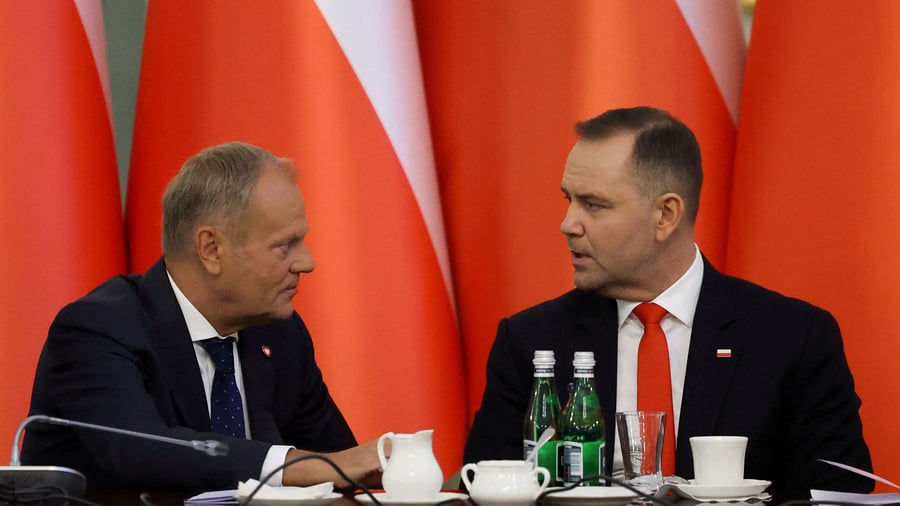
Polish Prime Minister Donald Tusk sees an end to Poland's constitutional crisis in sight, stating that the legal problem is resolved. Speaking in Warsaw on Thursday to the Handelsblatt and other international media, Tusk believes they are approaching the conclusion of the highly emotional phase of the conflict. For months, Tusk's pro-European government has been locked in a bitter power struggle with right-wing President Karol Nawrocki.
The dispute has recently escalated to an open confrontation between Poland's highest constitutional bodies, with protests lasting several days before the Constitutional Tribunal. Nawrocki refuses to swear in several constitutionally elected judges named by the Parliament and blocks the appointment of numerous ambassadors chosen by the government.
Radoslaw Sikorski, Poland's Foreign Minister, says 46 appointments are waiting for his signature. Tusk plans to urge the president to concede and is considering a "four-eyes" meeting with Nawrocki. "When I speak with the president, I will try to convince him that it is in our mutual interest to dampen emotions surrounding the situation at the Constitutional Tribunal or at least keep them completely under control," Tusk said.
However, it remains uncertain whether the conflict can be resolved. The president accuses Tusk of attempting to bring the Constitutional Court under his government's control, while Tusk accuses Nawrocki of sabotaging the restoration of the rule of law. The European Union may play a role in resolving the conflict, with Polish Justice Minister Waldemar Zurek stating his government is open to EU mediation.
However, the EU has not offered or requested such talks. The underlying issue is a conflict over the independence of Poland's judiciary that has been simmering for over a decade. The nationalist PiS party, during its 2015-2023 rule, packed numerous judicial positions with political allies, sparking a long-standing dispute with the EU.
The European Court of Justice ruled in December 2025 that Poland's Constitutional Tribunal did not meet European standards for an independent and impartial court. Since taking office in late 2023, Tusk has been trying to undo controversial judicial reforms, facing resistance from former President Andrzej Duda and current President Nawrocki, both of whom are supported by the PiS party.
Protests before the Constitutional Tribunal ensued after Nawrocki refused to swear in newly elected judges appointed by the Parliament. These judges swore their oaths in Parliament without the president's presence. Despite being appointed by the PiS, Gerichtspräsident Bogdan Swieczkowski did not recognize their appointment and refused them access to the court.
Last week, the longest-serving judge, Anna Korwin-Piotrowska, suspended Swieczkowski and his deputy, taking over court leadership. This decision sparked fierce protests from right-wing opposition and their supporters. Nawrocki canceled a trip abroad and returned to Warsaw. The conflict has economic implications as well. The EU had withheld billions in aid and imposed hefty fines on the EU Court of Justice due to the undermining of the rule of law by the previous PiS government.
Under Tusk's leadership, the EU had released the funds again. Economists at the Polish Bank PKO BP estimate that a prolonged institutional crisis could damage the country's creditworthiness rating.
Written by urgent.news from Handelsblatt's reporting — not their text. Machine-written — may contain errors; check the original before relying on it.