How Do You Land on a Moon With Almost No Gravity?
Last August, looking up from the edge of an ancient river delta on Mars, the Perseverance rover ’s electronic eye spied an oblong shadow crossing the distant, glowing Sun. Phobos , the Martian moon named for the Greek god of fear and panic, was transiting the solar disk. Too small to darken the pale, dust-tinged sky, but orbiting close enough to eclipse a significant fraction of the Sun, Phobos…
Last August, the Perseverance rover on Mars spotted Phobos, a small natural satellite, passing in front of the Sun from its surface. This rare event, known as a solar eclipse, occurred over a minute. Phobos, named after the Greek god of fear and panic, orbits Mars very close, making it difficult to discern its presence against the distant sky. Despite its tiny size, Phobos has a significant influence on Mars' orbital dynamics, presenting engineers with unique challenges when planning missions to the moon.
Phobos is an enigmatic moon, with its origins shrouded in mystery. It is believed to be either a captured asteroid from the asteroid belt between Mars and Jupiter, or a fragment of a larger celestial body that impacted Mars. Regardless of its origin, Phobos is a unique object due to its irregular shape, resembling a lumpy potato, and its weak gravity, only 1/1,800th of Earth's. An adult weighing 70 kilograms on Earth would only weigh about 0.04 kilograms on Phobos, making it challenging to land a rover on its surface.
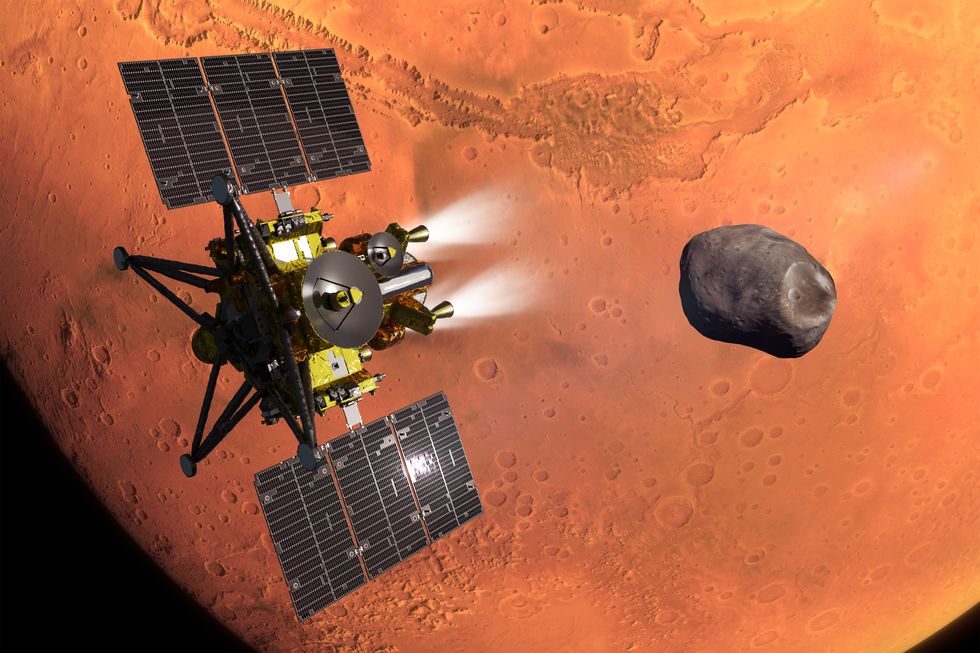
The upcoming Martian Moons eXploration (MMX) mission aims to investigate Phobos and its history, as well as gather samples to bring back to Earth. The mission faces significant challenges, including designing an orbit to study the moon's microgravity environment and figuring out how to land a rover on such a low-gravity object. Yasuhiro Kawakatsu, project manager of MMX at the Japan Aerospace Exploration Agency (JAXA), likens landing on Phobos to landing a balloon, emphasizing its inherent difficulty.
Phobos is a rubble pile, a loosely consolidated aggregate of rock and dust. Its small size and irregular shape make it different from traditional moons. The mission's rover, Idefix, is designed to explore the moon's surface, collect samples, and return them to Earth on a separate module. The MMX spacecraft itself consists of three modules: a propulsion module, an exploration and return module, and a return module.
The exploration module will carry the rover and scientific instruments, while the return module will ensure the sample capsule safely reenters Earth's atmosphere.
Navigating the complex orbits around Phobos and landing on its surface are among the mission's major challenges. MMX will need to carefully time its engine burns to enter Mars' orbit and then transition into a unique quasi-satellite orbit that allows it to follow Phobos closely without being captured by Mars' gravity. This orbit will enable the spacecraft to study Phobos up close while avoiding communication disruptions caused by Mars blocking its signal.
The mission's complexity, coupled with the unique characteristics of Phobos, makes it one of the most challenging space missions ever attempted.
Written by urgent.news from IEEE Spectrum's reporting — not their text. Machine-written — may contain errors; check the original before relying on it.