Giant exoplanet emerges from the dark when the James Webb Space Telescope turns out the starlight
Astronomers have filtered out starlight from James Webb Space Telescope observations to see a giant exoplanet emerge in the darkness.
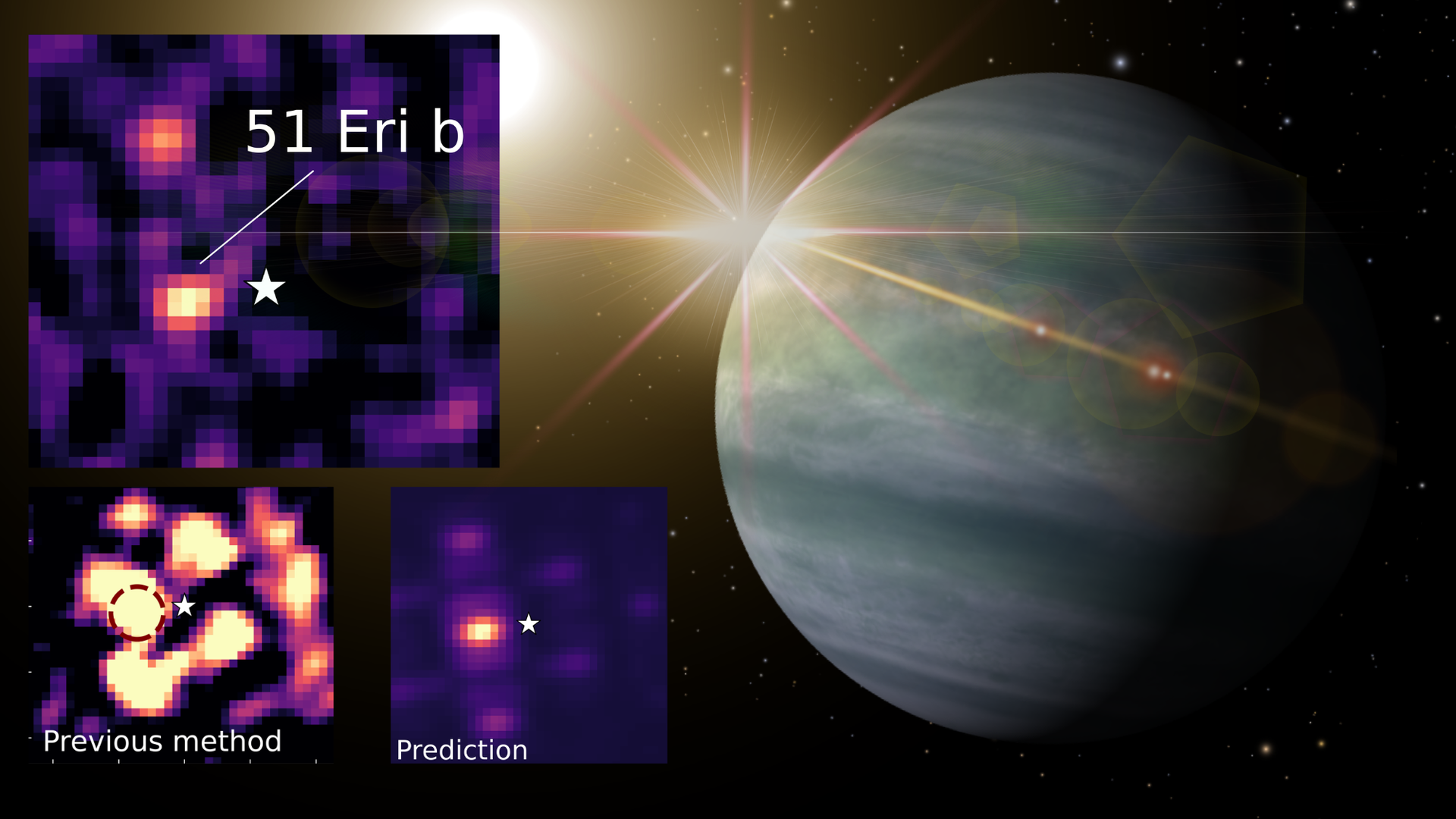
Astronomers have discovered a massive gas planet orbiting a star 97 light-years away using the James Webb Space Telescope, despite the star's glare. The exoplanet, 51 Eridani b, is nearly as massive as Jupiter and was previously undetectable due to its faintness compared to its host star. To overcome this challenge, scientists employed a technique called Physics-based Learning for Imaging Planets (FLIP).
This method creates a digital twin of the telescope, accounting for its imperfections and vibrations. By refining this digital twin, astronomers can subtract the star's light, revealing the hidden planet. Researchers tested FLIP on observations of two star systems with known exoplanets and one without, finding that the method detected the planet with unprecedented accuracy.
This breakthrough could enable the discovery of more planets, enhancing our understanding of planetary system formation and evolution, and potentially aid future missions like NASA's Habitable Worlds Observatory.
Written by urgent.news from Space.com's reporting — not their text. Machine-written — may contain errors; check the original before relying on it.